Showing Compassion Comes In Many Forms
- “The Bachelorette” alum Katie Thurston, 34, provided a roadmap for people wishing to better support loved ones battling cancer. She suggested things like helping with meal prep, household chores, including looking after pets, and a simple call or text checking in after treatment go a long way.
- Thurston is living with stage 4 breast cancer. She recently revealed her current treatment is showing progress as her tumors have shrunk.
- Stage 4, or metastatic, breast cancer occurs when cancer spreads beyond the breast to other parts of the body. While it is not curable, many treatment options are available to help manage the disease and extend quality of life.
- Loved ones of people battling a disease or cancer can show their support by getting involved and showing that they care, which can relieve added stress and anxiety.

Recently, in response to a fan asking how best to support someone battling cancer, Thurston offered a heartfelt and practical roadmap on an Instagram story — one filled with thoughtful gestures that caregivers and supporters often struggle to define. Her response serves as a powerful reminder that compassion doesn’t have to be loud to be life-changing.
Read More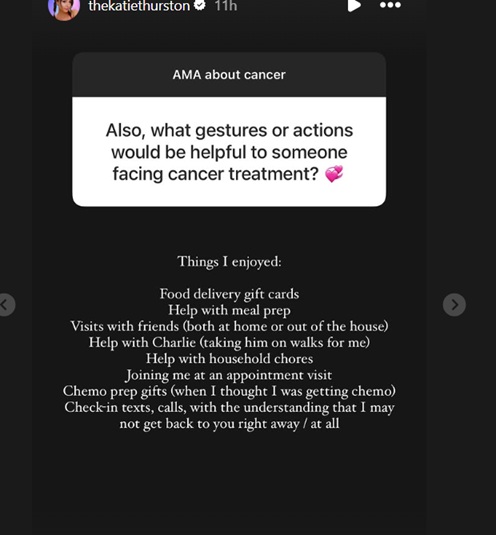 She went on to highlight the less obvious, yet equally impactful, ways people have shown up for her — including caring for her beloved dog, Charlie.
“Help with Charlie by taking him on walks,” she added.
Thurston also emphasized the importance of emotional presence. Whether it’s attending doctor appointments or simply checking in with a call or text, these actions serve as anchors during turbulent times.
“Even if you are not within arm’s reach,” Thurston said, “you can still show your support.”
Her words echo a broader truth: that being there — in small but intentional ways — can provide comfort, connection, and strength when someone needs it most.
Expert Resources for Metastatic Breast Cancer
- Are You A Metastatic Breast Cancer Patient Curious About The Drug Enhertu? Here’s What You Need To Know
- Metastatic Breast Cancer Sees Advancements in ‘New Era’ of HER2 Classification; Understanding HER2 Breast Cancer
- Metastatic Breast Cancer: You Are Not a Statistic
- Metastatic Breast Cancer: Biomarkers and Mutations That Matter
Supporting a Loved One Facing a Health Challenge
Research published in The Journal of the Royal Society of Medicine studied the impact of disease on family members. It found, “Most chronic diseases have similar effects on family members, including psychological and emotional functioning, disruption of leisure activities, effect on interpersonal relationships, and financial resources.”
If you have a loved one fighting a disease or cancer, SurvivorNet has some ideas to help you better support your loved one. Simple tasks like helping with household chores or running errands can do wonders for your loved one who’s diagnosed.
These tasks can make all the difference in relieving stress when the effect of chemotherapy brings on fatigue, for example. Other ideas to help your loved one battling cancer include cooking, bringing prepared meals, or doing an activity you enjoy together.
The support helps put your loved one battling a disease or cancer more at ease, as they may be overwhelmed with anxiety after a diagnosis or during intense treatment.
“There are a number of common things cancer patients can experience,” Dr. Shelly Tworoger, a researcher at Moffitt Cancer Center, told SurvivorNet.
“Anxiety, depression, financial toxicity, social isolation, and PTSD,” Dr. Tworoger said, are all emotions cancer warriors may experience and can be eased by loved ones.
If you are a caregiver of your loved one facing a diagnosis, it is important to maintain your mental and physical health.
“Caregiving is the most important job in the universe because you are there through the highs and lows,” Julie Bulger, manager of patient and family-centered care at Vanderbilt-Ingram Cancer Center, told SurvivorNet.
Caregivers must also watch out for “caregiver burnout,” where stress, anger, fatigue, and illness emerge from putting another person’s needs ahead of their own.
Caregivers who struggle to care for a cancer warrior should seek out a therapist or a support group, either online or in person.
What Does Caregiving Look Like?
Becoming a caregiver for someone with cancer is both a deep act of love and a significant responsibility. This role can include attending doctor visits, supporting treatments, helping with everyday tasks, and—perhaps most importantly—offering emotional comfort.
Caregivers often emerge from a patient’s close support circle: a spouse, parent, sibling, friend, or even a child. These individuals take on multiple roles to ease the journey for someone they care deeply about.
WATCH: Glenn Torchia talks about how he was there for his wife, Millie, while she battled stage 4 lung cancer.
Typical responsibilities include:
- Accompanying the patient to appointments
- Asking questions and taking notes
- Providing transportation
- Staying present during treatments
- Tracking side effects and symptoms
- Connecting with social workers or patient navigators
- Assisting with daily activities
- Offering steady emotional support
While caregivers serve as pillars for their loved ones, it’s essential that they don’t neglect their own need for support. Social workers and patient advocates can help guide caregivers through treatment logistics, mental health resources, and financial aid options.
“Patient navigators can function differently at different hospitals,” said Dr. Kathie-Ann Joseph, surgical oncologist at NYU Langone Health’s Perlmutter Cancer Center. “We have a really wonderful program at [NYU] where we use lay navigators, meaning they’re not nurses, although you can use nurses or social workers who pretty much help newly diagnosed cancer patients through the continuum of care.”
Understanding Thurston’s Diagnosis
Thurston’s cancer is classified as hormone receptor-positive (HR+) and HER2-negative (HER2-), the most common subtype of breast cancer. According to Penn Medicine, about 70% of new breast cancer cases each year fall into this category.
Hormone receptors are proteins found on breast cells that respond to estrogen or progesterone. When cancer cells have these receptors, they can grow in response to these hormones—making them hormone receptor-positive. HER2, on the other hand, is a protein that can accelerate cancer cell growth. Tumors are labeled HER2-positive when they overexpress this protein, and HER2-negative when they don’t.
Traditionally, HER2 status has been viewed in binary terms—positive or negative—though many patients fall somewhere in between. These classifications are determined by how the tumor appears under a microscope and through additional testing by a pathologist.

Thurston’s current regimen includes three key medications:
- Kisqali (ribociclib): Approved by the FDA in 2017, this targeted therapy is used in combination with endocrine therapy to treat HR+/HER2- breast cancer. It works by slowing the progression of cancer, offering a more tolerable alternative to traditional chemotherapy.
- Lupron (leuprolide): A hormone therapy injection that lowers estrogen levels in the body, helping to prevent the cancer from growing.
- Letrozole: An aromatase inhibitor that reduces the body’s estrogen production, commonly used in postmenopausal women with hormone-sensitive breast cancer.
Treatment Options for Advanced Breast Cancer
Metastatic breast cancer (also called stage 4) means cancer cells have spread from the breast to other parts of the body, which may include the bones, liver, lungs, brain, and beyond.
Breast cancer spreads through the bloodstream or lymphatic system. The blood carries cancer cells to different body parts, where they grow as new tumors.
As the cancer spreads to other body parts, patients may experience additional symptoms depending on where the cancer has spread. Examples include:
- Bones: Severe bone pain or fractures
- Lungs: Difficulty breathing, chest pain, new cough
- Liver: Yellowing of the skin (jaundice), abdominal pain, nausea, and/or vomiting
- Brain: Headaches, memory loss, changes in vision, seizures
WATCH: Treatment options for metastatic breast cancer.
Although stage 4 breast cancer is not curable, several treatment options exist that can extend the life of patients. Treatment options depend on the stage, type of primary breast cancer, and whether hormone receptors are positive.
Treatment can include a combination of:
- Chemotherapy: Oral or IV medications that are toxic to tumor cells
- Hormonal therapies: Drugs that lower estrogen levels or block estrogen receptors from allowing the cancer cells to grow
- Targeted therapies: Drugs that target your tumor’s specific gene mutations
- Immunotherapy: Medications that stimulate your immune system to recognize and attack cancer cells
- Radiation: The use of high-energy rays to kill tumor cells and shrink tumors
- Surgery: To remove a cancerous tumor or lymph nodes (uncommon with stage IV; more common in stages I, II, and III)
- Clinical trials: Studies of new medications, treatments, and other therapies offer hope for better outcomes.
Questions for Your Doctor
If your breast cancer journey involves metastasis, you may be wondering what to expect and if radiation therapy is an option for you. Here are some questions you can ask your doctor to get the conversation started:
- What type of breast cancer do I have?
- Does it have a risk of spreading?
- Does my breast cancer have a risk of spreading to my brain?
- Will radiation help treat the cancer in my brain?
- What type of radiotherapy do you recommend?
- How long does radiation treatment typically last?
- Will I have to take time away from work and daily activities?
- Would I be on any other forms of treatment while receiving radiation?
- How do you expect my cancer to respond to the treatment?
- What financial resources are available to me to help cover costs associated with radiation treatment?
- What’s the efficacy of radiation treatment?
Learn more about SurvivorNet's rigorous medical review process.