Enduring Radiation Treatment to Reach Remission
- Bestselling “It Ends With Us” author Colleen Hoover, 46, shared that she is now “cancer‑free” after keeping her 2025 diagnosis private until recently, revealing she underwent successful treatment.
- She told fans that genetic testing showed her cancer was not linked to family history, the Human Papillomavirus (HPV), or hormone-related causes—pointing instead to lifestyle and environmental factors.
- Germline (genetic) testing, which analyzes inherited DNA through blood or saliva, can help determine whether someone carries cancer-linked mutations; about 17 million Americans do, even without symptoms or family history, according to research published in JAMA.
- “Germline means we’re testing the DNA within the white cells or the buccal mucosa—the lining inside the mouth,” explains Dr. Jeff Jones, Professor of Urology at Baylor College of Medicine. “These are inheritable mutations, something that can be passed from one generation to the next.”
- Radiation therapy—part of Hoover’s treatment—has become far more precise in recent years; patients now undergo detailed simulation sessions to map the treatment area and ensure accurate, targeted delivery.
- “Normal tissue can repair that damage, while cancer cells can’t. We try to leverage that little delta into giving a little bit of radiation each day, and eventually killing the cancer cells where the cancer cells can’t grow and your body just reabsorbs those cancer cells,” Dr. Subhakar Mutyala, a board-certified radiation oncologist at Arizona Oncology, explained to SurvivorNet.
- Hoover chose to wait before going public with her diagnosis this year. Some people battling a disease or cancer are open to sharing their experiences as much as they can, while others prefer to keep it to themselves. SurvivorNet experts say both approaches and everything in between are valid.

“I was diagnosed sometime last year, had surgery that was successful, just finished radiation yesterday,” according to Fox News, adding, “I am done and good, and all is well and has been well.”
Read More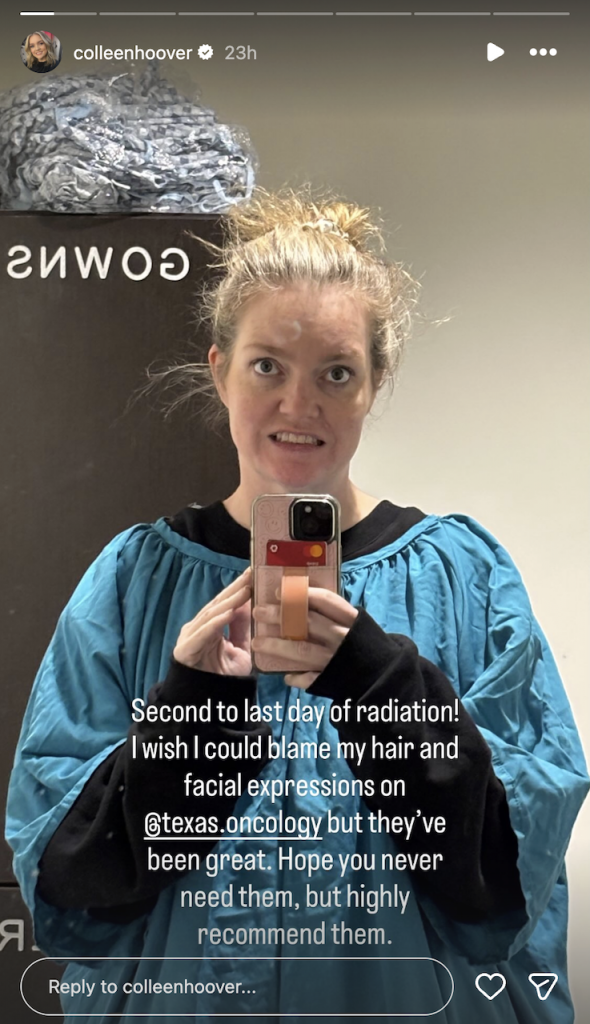
RELATED: What is Genetic Testing and Why is it Important?
“This means it was more than likely environmental/lifestyle, which includes a lack of exercise, poor diet, and stress,” she wrote with her trademark humor. “I’m happy and grateful to be alive, but I hate vegetables. I hate when I have to get off the couch. I hate sweating. I hate when science is right.”
RELATED: Why the HPV Vaccine Is So Important in Preventing Cancer
Understanding Genetic Testing That Helped Rule Out Hoover’s Cancer Origins
Germline testing evaluates a person’s inherited cancer risk using a blood or saliva sample.
“Germline means we’re testing the DNA within the white cells or the buccal mucosa—the lining inside the mouth,” explains Dr. Jeff Jones, Professor of Urology at Baylor College of Medicine. “These are inheritable mutations, something that can be passed from one generation to the next.”
Understanding your family’s medical history plays a major role in determining whether testing is appropriate.
“Asking questions about what might be going on with your aunts, uncles, cousins, grandparents—that’s going to make the process much easier for your genetic counselor and physician,” says Rachel Webster, a genetic counselor at MD Anderson Cancer Center.
U3fS9KI5
WATCH: How Genetic Counselors Can Help?
If cancer runs in your family, she adds, gathering as much information as possible is essential.
About 17 million Americans—roughly five percent of the population—carry a genetic mutation that increases their risk of developing cancer, even if they are healthy or have no family history of disease, according to research published in JAMA.
In the study, scientists analyzed more than 70 well-known cancer-related genes and identified over 3,400 unique mutations. One of the most effective ways for people to learn whether they carry these inherited mutations is through germline genetic testing.
Genetic counselors are available at many hospitals and related institutions to help patients navigate getting genetic testing.
Expert Resources on Radiotherapy
- CyberKnife Targets Radiation with the Same Effectiveness as Traditional Treatments
- Good News: Acupuncture May Offer Relief for Radiation Dry Mouth
- High-Dose Radiation: The Benefit May Outweigh The Risk
- Lifting the Ban on Skin Creams Before Radiation Treatment
- Radiation Boom–The Increasingly Popular Choice For Later Stage Cancer
- Targeted Radiation for Bone Pain
What Goes Into Radiation Treatment, Similar to Hoover’s Experience?
While radiation is approached differently depending on the patient’s specific cancer, generally speaking, it utilizes high-powered X-rays to target and destroy cancer cells.
“Radiation therapy is actually ionizing energy, where energy goes through your body, essentially causes DNA damage,” Dr. Subhakar Mutyala, a board-certified radiation oncologist at Arizona Oncology, explained to SurvivorNet.
WATCH: What Does Radiation Feel Like?
“Normal tissue can repair that damage, while cancer cells can’t. We try to leverage that little delta into giving a little bit of radiation each day, and eventually killing the cancer cells where the cancer cells can’t grow and your body just reabsorbs those cancer cells,” Dr. Mutyala added.
Again, Hoover has not revealed her specific cancer type to know what the standard of care and radiation protocol she endured.
Patients may be able to prepare for radiation therapy before it begins in earnest.
Dr. Chelsea Pinnix, a radiation oncologist at MD Anderson Cancer Center, says many patients are more afraid of radiation therapy than they need to be.
“Radiation is often a big black box for patients and very scary at first,” she explains. “You read things online or come across older studies that focused on toxicity, and that can heighten the fear.”
But much of that fear, she says, is rooted in outdated information. To illustrate how far the field has come, she compares radiation therapy to the evolution of the cell phone.
“Decades ago, cell phones were huge. Now we have smartphones that can do everything. Radiation therapy has evolved in the same way.” While the way radiation destroys cancer cells hasn’t changed, she notes, “a lot has changed in how precisely we target and deliver treatment.”
Before radiation begins, patients undergo a simulation—a planning session designed to ensure the highest accuracy once treatment starts. No radiation is delivered during this step.
WATCH: Preparing for Radiation Treatment
What Happens During Radiation Simulation
The first task is determining the exact position your body should be in for treatment. The position must give the machine the best access to the treatment area while still being comfortable enough for you to stay completely still for several minutes at a time.
Depending on the treatment site, you may lie on your back, stomach, or side. Specialized cushions and supports help keep your body in the same position for every session.
For head or neck treatments, a custom plastic mask is molded to your face and secured to the table to prevent movement.
“We have a lot of sophisticated devices to help with setup because we can now target down to the millimeter,” Dr. Pinnix says. “Consistency in positioning is crucial with today’s highly focused radiation.”
Once you’re positioned, the team performs a CT scan of the treatment area. These images guide the radiation plan and help pinpoint exactly where the beams should be directed.
Next, the team marks your skin—either with a temporary marker or tiny tattoo dots about the size of a freckle—so the radiation can be delivered to the same precise location each time.
The entire simulation typically takes up to an hour and offers a valuable opportunity to ask questions about the process, what to expect, and how treatment works.
Figuring Out If You’re Ready to Share Your Diagnosis
Hoover waited some time before going public with her diagnosis. Everyone navigates health challenges differently—some individuals facing cancer or chronic disease choose to openly share their stories, while others confide only in those closest to them. According to SurvivorNet experts, there’s no one-size-fits-all approach—every way of coping, from public to private, is entirely valid.
WATCH: Sharing a Diagnosis
“Patients who have just been diagnosed with cancer sometimes wonder how they are going to handle the diagnosis in social situations,” explains psychiatrist Dr. Lori Plutchik.
She says many wrestle with questions like, “How much information should they share, and with whom should they share it?”
“There is no one right way to handle this diagnosis,” Dr. Plutchik emphasizes. “People should do what feels right to them.”
Because a cancer journey can last months—even years—patients often face ongoing uncertainty about their health, and this lack of clarity can greatly influence when, and how, someone chooses to share their diagnosis, she adds.
Dr. Plutchik also underscores the importance of respecting boundaries: loved ones and friends should honor the patient’s preferences about what they’re ready to disclose and when they’re ready to seek support.
Questions to Ask Your Doctor
If you’re battling cancer or on the other side of it, and you’re struggling with your outlook on life, here are some questions you may consider asking your doctor to get the conversation started:
- What can I do if I’m struggling to be thankful for what I have in my life?
- Are there local resources for people wishing to improve their mental health?
- What else can I do to help reduce my stress level during my cancer journey?
- It’s difficult for me to find happiness and joy. How can I find help?
Learn more about SurvivorNet's rigorous medical review process.