CAR T-Cell Therapy Offering Hope to Blood Cancer Patients
- Journalist and author Jonathan Gluck is currently in complete remission from a rare type of blood cancer called multiple myeloma and it’s all thanks to CAR T-cell therapy—a treatment that finally led him into “complete remission.”
- Gluck shares his story and how he powered through adversity in his new memoir, An Exercise in Uncertainty: A Memoir of Illness and Hope, which was published on June 10 by Penguin Random House.
- CAR T-cell therapy reprograms a patient’s own immune cells to recognize and destroy cancer cells. Doctors reengineer a patient’s immune system by drawing blood and separating the T-cells. Then, using a harmless virus, the T-cells are genetically engineered to produce proteins called chimeric antigen receptors (CARs) on their surface. These receptors enable the cells to recognize and attach to a matching protein, called an antigen, on the tumor cell, just as a key fits into a lock. The process primes the T-cell to recognize the cancer and to fight it.
- Multiple FDA-approved CAR T-cell therapies are now available for blood cancers, including lymphomas, various forms of leukemia, and most recently, multiple myeloma.
The loving husband and father of two, now 60, initially thought he had a minorly twisted hip after having a mishap on ice outside of his office back in November 2002.
Read MoreA doctor’s visit in November 2023 prompted him to get an MRI, ultimately leading to his diagnosis of multiple myeloma.

Gluck admits that cancer was the “absolute last thing on my mind” because he was young, considered himself healthy, and had no family history of cancer.
“You don’t think of hip pain as a classic symptom of cancer. I figured worst case, maybe he [the doctor] was going to tell me I had a torn cartilage or something,” he recalls, revealing a tumor on his hip led to his blood cancer diagnosis.
Reflecting on when he received his diagnosis, Gluck was told his “prognosis was very poor” and he’s be very lucky if he lived for another several years.
However, it’s been 21 years since his diagnosis, and he’s sharing his story to spread awareness and hope for others faced with uncertainty like himself with his new memoir, An Exercise in Uncertainty: A Memoir of Illness and Hope.
Despite being in and out of remission for two decades, Gluck has maintained his desire and commitment to doing whatever treatments needed to manage the diseease.
Gluck underwent multiple rounds of radiation therapy, chemotherapy, and immunotherapy until he found a treatment called CAR T-cell therapy, a pioneering approach that uses his own genetically modified immune cells to combat the disease.
“I was hospitalized for several weeks in the summer of 2023 when I received that treatment. And miraculously enough that put me into a complete remission. And that’s my status at the time for right now,” Gluck says.
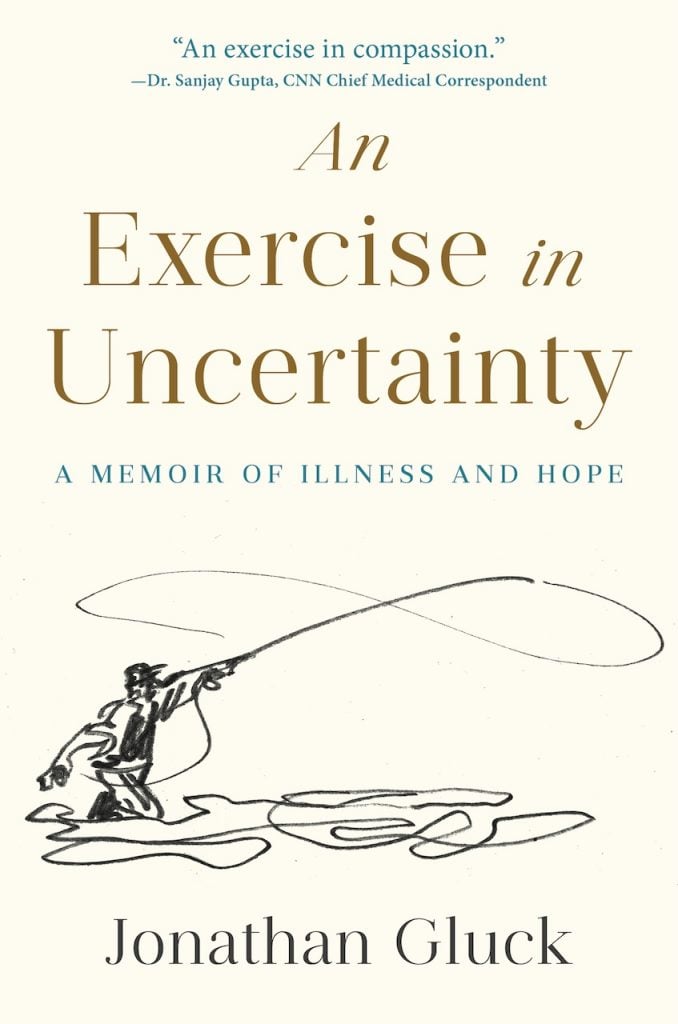
Gluck also elaborates on what kept him motivated to fight the disease—his family and fly fishing.
“I think it’s important to have something in your life that is deeply absorbing to you that takes your mind off of whatever difficulty you’re going through, especially where you have a serious illness or some other serious difficulty that’s can be a heavy load to carry. So for me, that’s fly fishing,” he explains.
“It doesn’t have to be that for some people it’s meditation or baking or knitting. It doesn’t matter what it is. I think having something that reliably brings you joy and takes your mind off of your day-to-day troubles or your more serious troubles is super important.”
He also prioritizes living his life as fully as possible, as his diagnosis left him with a perspective shift.
“I really do try to live my life as fully and richly as I can. So if that means I think of a friend and I haven’t talked to in a while, maybe I’ll text them that minute or call them or ask them if they want to have lunch or coffee or dinner. If that means there’s something crosses my radar, like a concert that I want to see, I’ll buy the tickets like that day,” Gluck tells SurvivorNet.
“If that means there’s a place I want to go travel to that I have a bucket list, kind of a trip that I haven’t done yet, all things being equal, I try and do that as quickly, get that on my calendar as quickly as I can, and just having those things to do and looking forward to things and trying to consistently do things I enjoy that make me happy, that helps keep the darker thoughts away.

Gluck’s new memoir chronicles his journey with multiple myeloma, from how it has affected both his physical and mental health, in addition to his relationships, career, and finances.
The book also offers readers encouragement on how to live a vibrant life, showing them first hand that even if a series of unfortunate events come your way, there’s still a way to play it with strength and purpose—and that path can lead to a life filled with joy, meaning, and fulfillment.
Understanding Multiple Myeloma
Multiple myeloma is a rare and incurable type of blood cancer. When you have this cancer, white blood cells called plasma cells (the cells that make antibodies to fight infections) in your bone marrow grow out of proportion to healthy cells. Those abnormal cells leave less room for your body’s healthy blood cells to fight infections. They can also spread to other parts of your body and cause problems with organs like your kidneys.
RELATED: Multiple Myeloma: Prevention & Screening
“In general, having blood cancer means that your bone marrow is not functioning correctly,” Dr. Nina Shah, a hematologist at the University of California San Francisco, explained to SurvivorNet.
Expert Resources On Multiple Myeloma
- CAR T-Cell Therapy: A Promising New Approach to Relapsed Multiple Myeloma
- Choosing the Best Treatment for Relapsed Multiple Myeloma
- Clinical Trials for Multiple Myeloma: Why They Matter
- Deciding Which Approach to Take During the Maintenance Phase of Multiple Myeloma Treatment
- Diagnosis: Do I Have Multiple Myeloma?
Known risk factors for multiple myeloma include your age, family history of cancer, and if you have monoclonal gammopathy of undetermined significance (MGUS). MGUS is a condition that occurs when you have too much monoclonal protein in your blood and bone marrow.
Most people diagnosed are in their 60s. However, people younger than 60 can still get this type of cancer also, if you have a close relative with multiple myeloma that can increase your risk.
WATCH: Recognizing multiple myeloma symptoms.
Multiple myeloma can cause symptoms such as weakness, dizziness, bone pain, and confusion, among other symptoms.
Doctors use blood and urine tests and imaging tests such as X-rays or MRIs to help diagnose multiple myeloma and to guide treatment options. Ultimately, a bone marrow biopsy will confirm the diagnosis.
Understanding CAR-T Cell Therapy
CAR T-cell therapy transforms a patient’s own immune cells into powerful cancer fighters. The journey begins with T-cells—white blood cells that help the immune system detect and destroy threats like viruses and cancer. Once collected from the patient’s blood, these cells are sent to a lab, where scientists use an inactivated virus to insert new genetic instructions.
These new genes teach the T-cells to produce special surface proteins known as receptors, allowing them to better recognize cancer cells. The modified cells are then multiplied in large numbers and infused back into the patient.
WATCH: The Value of CAR T-Cell Therapy for Patients.
Once inside the body, these re-engineered T-cells go to work, locking onto matching proteins—called antigens—on cancer cells and attacking them directly.
Dr. Siddhartha Ganguly, Carol Cockrell Curran Distinguished Centennial Chief in Hematologic Oncology at Houston Methodist Hospital and Neal Cancer Center, compares this cutting-edge therapy to a classic video game.
“CAR-T therapy aims to give ‘eyes’ to the T-cells. We remove the T-cells from the body by a blood draw, send them to the lab, and insert an anti-cancer gene before infusing them back into the patient. This gene allows the T-cell to ‘see’ the cancer cells… They will seek out the cancer and kill it, much like the video game Pacman,” Dr. Ganguly told SurvivorNet.
He notes that while CAR T-cell therapy, like many treatments, comes with possible side effects, it offers substantial hope for patients facing hard-to-treat blood cancers like advanced lymphoma and multiple myeloma.
A Deeper Look Into the Reengineering Process
Doctors reengineer a patient’s immune system with CAR T-cell therapy by first drawing blood and separating out the T-cells.
Then, using a harmless virus, the T-cells are genetically engineered to produce proteins called chimeric antigen receptors (CARs) on their surface. These receptors enable the cells to recognize and attach to a matching protein, called an antigen, on the tumor cell, just as a key fits into a lock. The process primes the T-cell to recognize the cancer and to fight it.
Next, the modified cells are multiplied into the millions in a laboratory.
The CAR T-cells are specific to your cancer. For example, some types of lymphoma cells have the antigen CD19 on their surface. CAR T-cell therapies for those cancer types only target the CD19 antigen.
A few days before the infusion, you’ll get chemotherapy to clear out some of your immune cells and prime your body to receive the CAR T-cells. This will help the CAR T-cells work better.
Finally, the modified T-cells will be infused back into your body to hunt down the cancer.
Several FDA-approved CAR T-cell therapies are currently in use, including:
Abecma (idecabtagene vicleucel)
Breyanzi (lisocabtagene maraleucel)
Carvykti (ciltacabtagene autoleucel)
Kymriah (tisagenlecleucel)
Tecartus (brexucabtagene autoleucel)
Yescarta (axicabtagene ciloleucel)
These therapies are used to treat various blood cancers, such as certain leukemias, lymphomas, and, more recently, multiple myeloma.
What’s the Effectiveness of CAR T-cell Therapy?
CAR T-cell therapy has delivered promising outcomes for patients with certain blood cancers, showing response rates as high as 80% in cases where other treatments have failed. For individuals with lymphoma, more than 54% of those treated with the FDA-approved therapy axicabtagene ciloleucel (Yescarta) and 40% of those who received tisagenlecleucel (Kymriah) achieved a complete response, meaning no detectable cancer remained.
Remarkably, among those treated with Yescarta, 40% remained in remission an average of 15 months following their infusion.
Typically, patients who receive CAR T-cell therapy have already had at least two previous treatments, often including rituximab (Rituxan) with chemotherapy and high-dose chemotherapy.
“Some of these patients had three, four, or five prior lines of therapy, and we were able to save their lives,” said Dr. Stephen Schuster, director of the Abramson Cancer Center’s lymphoma program, in an interview with SurvivorNet.
Medical research has shown response rates of between 80 and 100 percent. “It’s really unprecedented. This is something we had never seen before for patients who have had six or seven prior lines of therapy,” says Dr. Nina Shah, a hematologist with the University of California, San Francisco Medical Center.
CAR T-Cell Therapy Side Effects
CAR T-cell therapy is a form of cancer treatment that differs from traditional chemotherapy in a significant way: it generally doesn’t cause hair loss or nausea. But like any powerful treatment, it comes with its own set of side effects.
As CAR T-cells multiply in the body, they release inflammatory proteins called cytokines. This can trigger a condition known as cytokine release syndrome (CRS), which may cause symptoms like high fever, weakness, chills, and low blood pressure. Another potential side effect involves neurological changes, which can lead to confusion or a decreased sense of awareness.
WATCH: CAR T-Cell Therapy Side Effects
When side effects do appear, the most common and least severe is fatigue.
“That’s very normal, and it usually resolves in the first month,” says hematologist Dr. Nina Shah.
However, CRS can sometimes be more serious. It occurs when the therapy causes a surge of cytokines—tiny immune-signaling proteins—to flood the bloodstream. This response can bring on a range of symptoms, from mild flu-like effects to more severe reactions.
Typical CRS symptoms include headache, fever, chills, scratchy throat, nausea, vomiting, diarrhea, joint or muscle pain, and extreme fatigue. In more serious cases, it can cause shortness of breath, low blood pressure, or a rapid heart rate. While most patients experience only mild to moderate reactions, it’s important to note that CRS can, in rare instances, become life-threatening.
Currently, scientists aren’t sure whether the side effects correlate with how well the treatment is working, so it’s difficult to tell patients whether their side effects or lack of them are a good or bad thing. “All I can say is that every patient is different, and every patient has a different course,” says Dr. Shah.
Data shows that the quality of life for people who have undergone CAR T-cell therapy “actually improves when we talk about pain, fatigue, and emotional and social functioning. And so, whether or not you experience side effects, we hope that this therapy will improve your quality of life,” says Dr. Shah.
If you’re considering CAR T-cell therapy, talk with your doctor about all potential side effects—the mild, the serious, and everything in between.
Treatment doesn’t end once you’ve received the CAR T-cell infusion. “They typically have to be monitored very carefully after that for a number of weeks or even months, due to some of the potential side effects,” Dr. Julie Vose, chief of hematology/oncology at the University of Nebraska Medical Center, tells SurvivorNet.
Questions to Ask Your Doctor
- Am I a candidate for CAR T-cell therapy?
- What are the potential risks and side effects?
- What are the chances of success for my specific cancer type?
- What does the treatment process involve?
- Where will I receive treatment, and how often?
- Are there alternative treatments I should consider?
- What is the cost, and will my insurance cover it?
- What experience does this center have with CAR T-cell therapy?
- What kind of follow-up care will I need?
- Can I speak with other patients who’ve undergone this therapy?
Contributing: SurvivorNet Staff
Learn more about SurvivorNet's rigorous medical review process.