
Living With Metastatic Prostate Cancer
- Cartoonist Scott Adams announced that Kaiser Permanente of Northern California has finally received his Pluvicto application, an FDA-approved drug for metastatic prostate cancer. However, he says scheduling issues have prevented him from starting treatment, prompting him to raise the case on X (formerly Twitter) and subsequently receive enormous attention. His situation highlights the broader struggle many cancer patients face in accessing timely care and medications.
- Pluvicto (lutetium Lu 177 vipivotide tetraxetan) was approved by the Food and Drug Administration in March 2022. The drug specifically treats patients with a type of disease called prostate-specific membrane antigen (PSMA)-positive metastatic castration-resistant prostate cancer (mCRPC).
- If you’re having trouble accessing medication or treatment, ask your doctors to advocate on your behalf with insurance companies and explore all available options. You can also reach out to social workers for additional support and learn about compassionate use programs, which allow patients with serious illnesses to access investigational medical products outside of clinical trials.
- Patient navigators and social workers can help patients navigate the system, such as traveling to a new facility for treatment with more supply or planning what questions to ask.
- However, different therapies may bring new financial concerns. There are local and national organizations that may be able to help cover your treatment costs if you’re struggling to pay your bills.
His update highlights the difficulties many patients encounter in getting access to certain medications, treatments, or support during their battle with cancer—particularly since most people cannot turn to the President for expedited care.
Read MoreIn order to use the drug, patients are first given a PET scan using a special imaging agent which aids in the detection of cancer cells in the body that are PSMA positive.
“The use of Pluvicto is coupled with a PET imaging agent that detects the PSMA-positive metastatic lesions throughout the body, explains Dr. Ghassan El-Haddad of the Moffitt Cancer Center. If the patients have PSMA-positive metastatic lesions on PET, then they would be eligible for the therapy. This combination of a (therapy that can deliver radiation to target cells) with an imaging biomarker positivity is a great example of precision medicine or what we call in nuclear medicine, theranostics (therapeutics + diagnostics).”

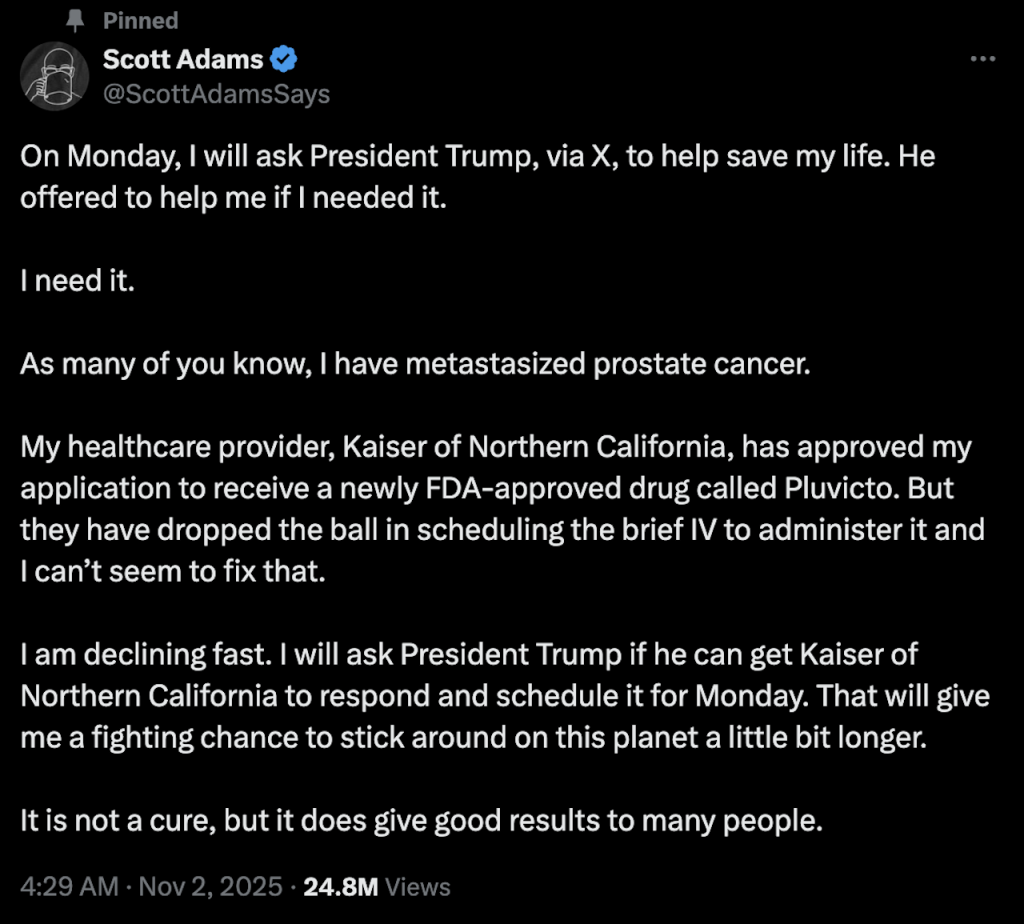
The native New Yorker living in California, wrote on “X” this week, “As many of you know, I have metastasized prostate cancer.
“My healthcare provider, Kaiser of Northern California, has approved my application to receive a newly FDA-approved drug called Pluvicto. But they have dropped the ball in scheduling the brief IV to administer it and I can’t seem to fix that.”
RELATED: Metastatic Prostate Cancer Treatment is Improving
After mentioning that his health is “declining fast,” Adams said he’s trying to get a prompt response from Kaiser in order to schedule treatment as soon as possible.
“That will give me a fighting chance to stick around on this planet a little bit longer. It is not a cure, but it does give good results to many people,” he concluded.
How Patients, Like Scott Adams, Can Get Help
It’s impressive how Adams was able to quickly grasp the attention of the President, but for all other cancer patients across the U.S., seeking help in their cancer fight is obtained through the help of doctors or patient navigators.
If you’re having trouble accessing medication or treatment, ask your doctors to advocate on your behalf with insurance companies and explore all available options.
You can also reach out to social workers for additional support and learn about compassionate use programs, which allow patients with serious illnesses to access investigational medical products outside of clinical trials.
Meanwhile, a patient navigator is a professional who guides individuals through every stage of their cancer experience — from diagnosis and treatment to managing financial concerns, transportation, and follow-up appointments. This added support can be extremely helpful when patients are coping with overwhelming emotions and processing a great deal of new information.
“Patient navigators can function differently at different hospitals,” Dr. Kathie-Ann Joseph, a surgical oncologist at NYU Langone Health’s Perlmutter Cancer Center, told SurvivorNet in an earlier interview.
RELATED: How Patient Navigators Help With Finances, Transportation & More During Your Cancer Journey
“We have a really wonderful program at [NYU] where we used lay navigators, meaning they’re not nurses although you can use nurses or social workers, that pretty much help newly diagnosed cancer patients through the continuum of care.”
These navigators can meet with patients from their first doctors appointments, and can also:
- Attend appointments
- Provide an assessment for next steps of care
- Assist with housing, transportation or immigration issues
- Help with financial issues
- Provide direction on legal issues
“They really will help them get through these barriers that we think could impact their care,” Dr. Joseph added. “Because the goal is we want them to complete their care.”
Check out our related content on how social workers can help during the cancer treatment process.
Adam’s Prostate Cancer Fight
Back in May, Adams admitted that former President Joe Biden’s cancer prognosis inspired him to come forward with his own diagnosis on his YouTube show “Real Coffee With Scott Adams YouTube.” He explained, “I have the same cancer that Joe Biden has. I also have prostate cancer that has also spread to my bones, but I’ve had it longer than he’s had it, well longer than he’s admitted having it.
“So my life expectancy is maybe this summer. I expect to be checking out from this domain sometime this summer. The disease is already intolerable. I don’t have good days … I’m always in pain. And pain moves around to different parts of my body. I’ve been using a walker to walk for months now.”
However, last month, he revealed his pain had significantly decreased thanks to the hormone therapy he has received.
During his conversation on the “Real Talk with Zuby” podcast, “Adams admitted he has planned to end his life through the California End of Life Option Act (EOLOA) due to his immense discomfort. However, seeing how hormonal therapy changed his life, he’s decided not to move forward with that and pursue further treatment with renewed hope.
He told Zuby, “It [ending his life] was going to be maybe around the last day of June. But about two weeks before that, I tried some hormone therapy, just pills. And I hadn’t done them before because I didn’t want to turn off my testosterone. And I thought, well, that’s the same as dying, if you’re a guy. To me, it felt like, well, I’m not going to be me anymore. I’m not really committed to that other person you’re trying to turn me into. So I skipped that. But it probably would help.
“Now, it turns out that some people respond really well to the hormone, which just takes away your testosterone, basically. So in one week of taking the testosterone blockers, all of my symptoms went away. All of them. I have no pain. I’m back to working out. I’ve run pretty much a full schedule, except I need a nap in the afternoon, usually.”
View this post on Instagram
He continued, “But otherwise, I didn’t think that was even possible. So I guess that happens for some people. They’re just really sensitive to the, I guess, my testosterone was feeding the cancer. So we just started. And I think even the tumors have shrunk because I have no physical pain anywhere in my body where it was really brutal for weeks and weeks before that.”
Metastatic prostate cancer occurs when the disease extends beyond the prostate, spreading to other parts of the body. Although receiving this diagnosis can be daunting, many effective treatment options are now available, with hormone therapy remaining the cornerstone of treatment, like what Adams has received.
Understanding How Pluvicto Works
Dr. Yen tells SurvivorNet, to grasp how Pluvicto (lutetium Lu 177 vipivotide tetraxetan) works, it’s important to first understand metastatic castration-resistant prostate cancer, or mCRPC. In advanced stages, prostate cancer can extend beyond the prostate gland, spreading to areas such as the bones or lymph nodes. This stage of the disease is referred to as “metastatic” prostate cancer.
A typical initial approach for treating advanced prostate cancer involves hormone therapy, also called androgen deprivation therapy (ADT). This method works by reducing or blocking testosterone, a hormone that promotes the growth of most prostate cancer cells. Hormone therapy is often highly effective, frequently slowing or stopping the cancer’s advancement for months or even years.
Expert Resources On Metastatic Prostate Cancer
- Metastatic Prostate Cancer Basics: What Is It & How Is It Treated?
- Metastatic Prostate Cancer Treatment is Improving
- Metastatic Prostate Cancer: Costs and Benefits of Molecular Testing
- Combination Therapy: Elevating the Standard for Metastatic Prostate Cancer Care
- How Is Radiation Used For Metastatic Prostate Cancer?
- Pluvicto Provides Hope For Veterans with Metastatic Prostate Cancer
- Types Of Metastatic Prostate Cancer & Treatment Options
However, for many patients, the cancer eventually becomes “castration-resistant,” meaning that even with very low levels of testosterone, the cancer finds ways to continue growing and spreading. When this happens, it becomes mCRPC. This stage of the disease can be particularly challenging to treat, as it has become more aggressive and requires different strategies beyond initial hormone therapy. Patients facing mCRPC often experience symptoms that impair their quality of life, which underscores the urgent need for effective new treatments.
Historically, after hormone therapy, options might include chemotherapy or switching to a different type of hormone therapy. While these are vital tools in the fight against cancer, chemotherapy, in particular, can come with significant side effects that can negatively impact daily life, leading many patients and their doctors to prefer to delay or avoid it if possible. This is where a targeted therapy like Pluvicto offers a compelling new alternative.
Lutetium Lu 177 vipivotide tetraxetan, which is known by the brand name Pluvicto, is an innovative intravenous radioligand therapy specifically designed for patients with PSMA-positive mCRPC. It is the first and only targeted radioligand therapy for patients with PSMA-positive mCRPC before the need for chemotherapy, marking a significant advancement in treatment options.
“The PSMAfore study has looked at [Pluvicto] in the pre-chemotherapy setting, and again, it’s been FDA approved in that setting as well. So you could be utilizing it in patients after chemotherapy or before chemotherapy, as long as they have metastatic castration-resistant prostate cancer,” says Dr. Yen.
Pluvicto is FDA-approved for adults with PSMA-positive metastatic castration-resistant prostate cancer (mCRPC). Specifically, Pluvicto is indicated for patients who:
- Have a confirmed diagnosis of PSMA-positive mCRPC
- Have already been treated with an androgen receptor pathway inhibitor (ARPI) therapy
And, importantly, they are considered appropriate to delay taxane-based chemotherapy. This means that for many patients who wish to defer or avoid chemotherapy due to its side effects, Pluvicto now offers an effective alternative earlier than before. Previously, it was only approved after both hormone therapy and chemotherapy.
‘A Profound Effect’: Treating Advanced Prostate Cancer With Hormone Therapy
Before treatment, a crucial step is undergoing a PSMA PET scan. This scan uses a small amount of a different radioactive substance (gallium-68 gozetotide, or Locametz) that also binds to PSMA. This helps your doctor “see” where the cancer has spread and, most importantly, confirms that your cancer cells express enough PSMA. Although the FDA only approved 68Ga gozetotide PET imaging, there is an alternative (Pylarify, F-18 Piflufolastat), which is also permitted by the NCCN guidelines.
If the cancer cells “light up” on this scan, it indicates they will also bind to Pluvicto, making you a potential candidate for this targeted therapy.
Additional Resources For Patients Needing Assistance
While it remains unclear why Adams has not yet started Pluvicto treatment despite his confirmed eligibility, his story highlights the financial challenges and the critical support that cancer patients often need.
Cancer survivors and their loved ones helping them along their journeys who may be wondering what to do if the cancer drug they need is not available. SurvivorNet previously spoke with experts like social workers and patient navigators to provide some recommendations that can help people find solutions.
Remember, it’s always important to push for answers and evaluate other options. SurvivorNet experts recommend bringing a care partner with you to your appointments to help you listen, take notes, and process the information being given to you. This could include a spouse, partner, friend or other loved one.
And in most cases, there are other options for treatment. According to physicians who spoke to SurvivorNet, evaluating other potential treatment options when the specific drug you are used to is not available is a conversation that should be had with your care team. Be sure to ask about the effectiveness of the other options and if they have different side effects than you’re used to.
If a patient is involved in taking a new drug or getting accepted into a clinical trial, the best course of action is to connect with a cancer specialist in the field. It’s very important that you see a doctor who specializes in treating your specific type of cancer, usually in a high volume cancer center.
RELATED: SurvivorNet’s Guide To Clinical Trials: What Are They And Are They Right for You?
Another way to find a clinical trial is to talk with a patient navigator at your cancer hospital. Or, you can search through ongoing studies on ClinicalTrials.gov.
Additionally, social workers are available to help, and for those undergoing cancer treatment, they can be an incredible resource. One of the primary roles of a social worker is advocacy, according to Sarah Stapleton, a clinical social worker at Montefiore Medical Center. Social workers help with a variety of issues that arise with cancer treatment. They can connect you with financial resources to help pay for treatment, work with insurance companies, and provide emotional support for those who need it.
“If there is any barrier that you are finding, financial, transportation, or otherwise, a social worker is going to help advocate for you to try to do the best we can to eliminate that and make sure you get your treatment,” Stapleton says.
Meanwhile, here are some examples or programs and organizations that may be able to help with bills associated with cancer treatment:
For Help With Treatment Bills
- The Cancer Financial Assistance Coalition can direct patients and their families to available local services.
- Many treatment centers offer extended payment plans and some may offer temporary payment delays, according to the American Cancer Society.
- CancerCare, which connects patients with oncology social workers, may be able to assist with co-pays, transportation, and other costs associated with care.
- The HealthWell Foundation may be able to help uninsured patients pay for treatment.
- The American Cancer Society may be able to link patients and their families up with local resources (they offer a 24/7 helpline).
- The Patient Advocate Foundation (PAF) works with patients and their insurance companies to resolve issues and may provide direct financial support to some patients.
- The Patient Access Network Foundation may be able to help with out-of-pocket costs associated with cancer treatment.
For Help With Transportation and/or Housing
- There are several programs that may be able to assist patients if they need to travel by plane to get treatment, including Air Care Alliance, the Corporate Angel Network, and PALS (Patient Airlift Services).
- Patients with Medicaid may be entitled to help paying for transportation costs to and from treatment.
- The American Cancer Society’s Road to Recovery program can hook patients and their families up with volunteer drivers.
- Mercy Medical Angels may be able to help patients and their families pay for transportation.
- The Healthcare Hospitality Network can assist with housing if a patient must be treated far from home.
- The American Cancer Society Hope Lodge Program gives patients and their caregivers a free place to stay during treatment in dozens of cities across the U.S. and Puerto Rico.
For Help With Food
Food assistance may be available to people going through cancer treatment and their caregivers. Look into the Supplemental Nutrition Assistance Program aka SNAP or a program like Meals on Wheels.
Contributing: SurvivorNet Staff
Learn more about SurvivorNet's rigorous medical review process.


