Deciding When to Share a Cancer Diagnosis Can Be Tricky
- Colleen Hoover, bestselling author of “It Ends With Us,” has revealed she’s “doing much better” after sharing a photo from one of her final radiation sessions, thanking Texas Oncology for all their support.
- Although it’s unclear what type of cancer Hoover is battling, she did confirm the disease isn’t genetic. She thinks it likely resulted from lifestyle or environmental factors.
- Some people battling a disease like cancer are open to sharing their experiences as much as they can, while others prefer to keep it to themselves. SurvivorNet experts say both approaches and everything in between are valid.
- It’s important to remember that choosing to share a cancer journey is a personal choice, whether you’re a celebrity or not, and the same goes for other private topics.
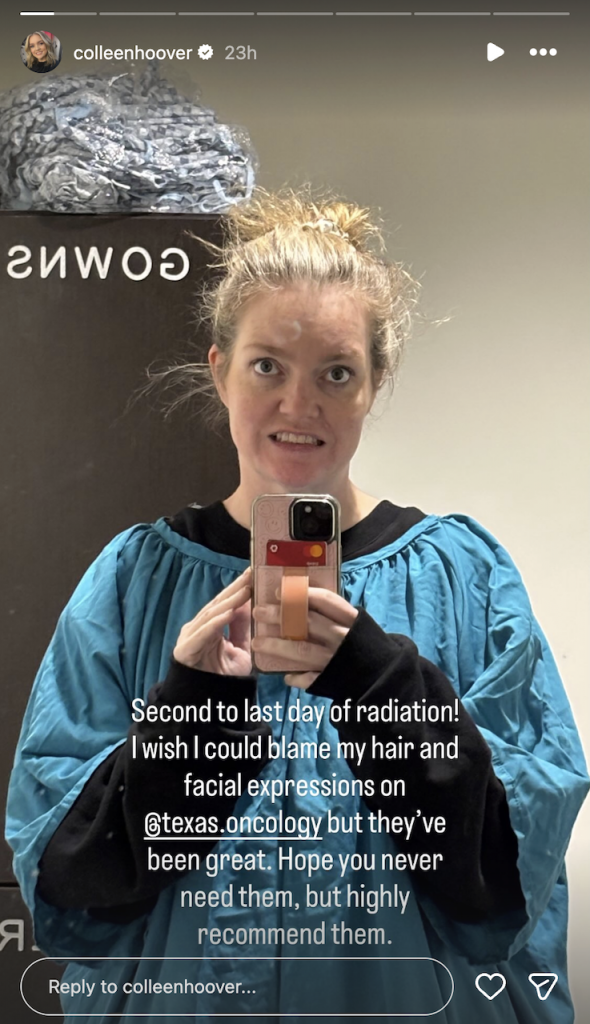
Hoover, a 46-year-old mom of three who just released her latest novel “Woman Down,” shared a photo on social media this week from one of her final radiation sessions, thanking Texas Oncololgy for their support.
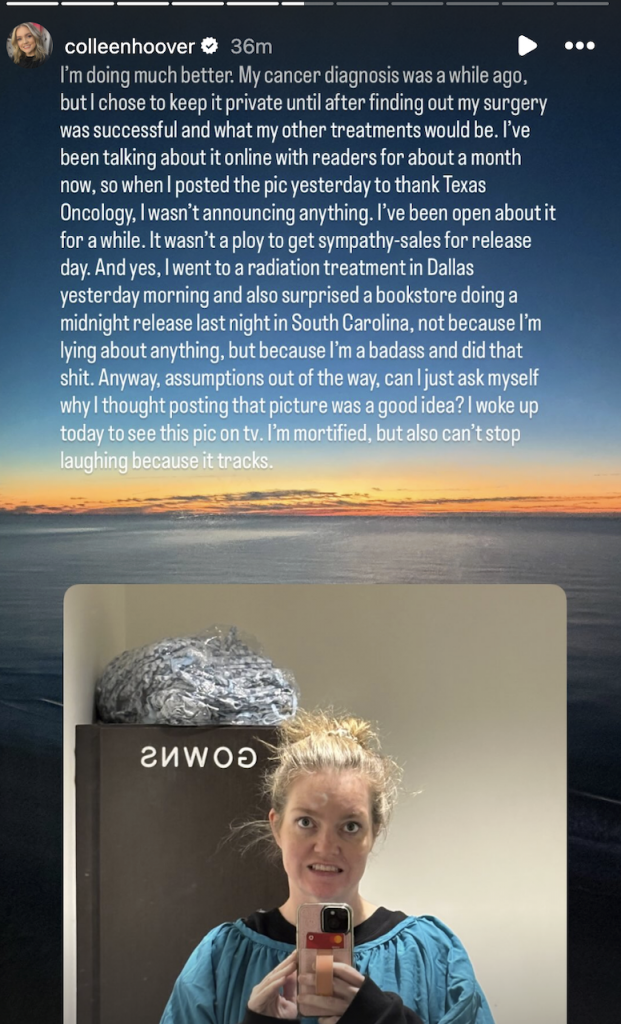
“My cancer diagnosis was a while ago, but I chose to keep it private until after finding out my surgery was successful and what my other treatments would be.”
View this post on Instagram
She continued, “I’ve been talking about it online with readers for about a month now, so when I posted the pic yesterday to thank Texas Oncology, I wasn’t announcing anything. I’ve been open about it for a while.”
“It wasn’t a ploy to get sympathy-sales for release day. And yes, I went to a radiation treatment in Dallas yesterday morning and also surprised a bookstore doing a midnight release last night in South Carolina, not because I’m lying about anything, but because I’m a badass and did that shit.
Hoover concluded, “Anyway, assumptions out of the way, can I just ask myself why I thought posting that picture was a good idea?
“I woke up this morning to see this pic on TV. I’m mortified, but also can’t stop laughing because it tracks.”
Hoover, who has not yet unveiled the type of cancer she’s been diagnosed with, also recently took to Facebook to share that the disease she’s battling was not linked to genetics.
Coping With Emotions During & After a Life-Changing Diagnosis
- Mental Health: Understanding the Three Wellsprings of Vitality
- SN & You Presents Mental Health: Coping With Emotions
- ‘Strong in Cancer’: How To Combat Financial Anxiety, Plus Tips For Making Difficult Treatment Decisions
- Mental Health: Coping With Feelings of Anger
- 7 Cancer Survivors Share How Gratitude, Faith, & Seeking the Good In Life Help Give Them Strength
- I Wanted to Be Me Again, But I Also Needed Their Help — Finding That Support System
She wrote on Facebook, “I got results back today from the geneticist that say my cancer did not come from family genes. It also didn’t come from the two main causes of the cancer, which are HPV and excessive hormones.
“This means it was more than likely environmental/lifestyle, which is lack of exercise, poor diet and stress. I’m happy and grateful to be alive but I hate vegetables. I hate when I have to get off the couch. I hate sweating. I hate when science is right.”
“If you see me at the gym, don’t even tell me good job. If you see me at a restaurant eating grilled chicken and drinking water, I’m probably real mad about it,” she added.
View this post on Instagram
The Choice to Share
The choice to share or not share one’s cancer diagnosis is a personal one for anyone facing the disease, even if they’re not a celebrity. While some people choose to share only with close friends and family, others post their entire journey on social media, create blogs and detail their treatments, side effects and doctor reports.
Survivor Lauren Chiarello talks about staying present in the moment while battling cancer.
According to Dr. Renee Exelbert, a licensed psychologist and founding director of The Metamorphosis Center for Psychological and Physical Change in New York, the decision to openly disclose or not disclose one’s diagnosis may be made more complicated for someone in the public eye, as they may feel pressure to serve as a role model, or to use their notable platform for the greater good.
She says public figures and celebrities are often held to a harsher standard, frequently having their appearance and behaviors rigorously evaluated. This might make hiding a cancer diagnosis more difficult and may also make disclosing a cancer diagnosis a greater burden to bear.
Also, just because someone is a public figure or celebrity does not spare them from judgment and the insensitive comments of others, especially while they may be fighting for their life.
Dr. Exelbert says the decision to disclose or not disclose a cancer diagnosis is a very individual and personal one in any case.
“Certain Individuals may feel as though their sense of self has been deeply impacted by their diagnosis, and they want to keep it private. At their core, certain individuals may struggle with appearing weak, vulnerable or sick, and particularly do not want to withstand the opinion or commentary of others while facing a cancer diagnosis,” she explained.
Additionally, some may feel that revealing a cancer diagnosis may pose a threat to their sense of professional identity and how capable they are perceived by others.”
Dr. Exelbert also said some may feel they don’t have the coping resources to withstand scrutiny, whereas others may welcome the distraction and attention. Most importantly, however, she said there is no right or wrong approach.
“When an individual experiences trauma, which cancer certainly is, they need to be in charge of how their story is told in order to avoid further disempowerment. Thus, the decision to disclose or not to disclose should be wholly and rightfully left up to each individual.”
So, is one way more beneficial than the other? Dr. Exelbert says there are pros and cons to sharing.
“A positive aspect of sharing one’s diagnosis on social media is the potential to receive an outpouring of support, occasionally from people all over the world who have experienced something similar, and who may be able to offer useful suggestions,” Exelbert adds. “Additionally, someone’s unique story may catch the attention of those performing clinical trials or offering unique treatment options, looking for participants.”
She said the ability to inspire countless people with one’s experience and story can also be a very powerful motivating factor.
Learn to Accept Yourself — A Huge Part of Living With Cancer
“Some individuals are looking to chronicle their journey, almost as testament to what they have experienced and to leave a legacy. It might additionally be beneficial to publicly share one’s story, as it can serve as a platform to educate others about cancer and its emotional and physical symptoms, as well as challenge stigma and change society.”
On the other hand, she says a con of revealing one’s diagnosis on social media is that people may share unsolicited stories of poor outcomes that they have either heard about, or experienced personally, many of which are unrelated to your particular situation. For example, some may tell you they know someone who had the same type of cancer, but died, which can be overwhelming and create undue stress.
“Additionally, once you share your diagnosis, you often have to manage the emotional experience of others,” Dr. Exelbert told SurvivorNet. “Sometimes, people will be very upset by your diagnosis and need you to take care of them or make your situation easier for them to deal with. This can prove quite difficult when you are barely in control of managing your own emotions. Further, many individuals might find it quite difficult to present themselves in such a vulnerable way on social media, as many often utilize this medium to garner accolades from presenting their ‘ideal self’ versus their ‘real self.’”
No matter what someone’s choice is when it comes to sharing a cancer diagnosis, the most important thing is that they feel support. For some, support from a few close friends, family members or professionals may be enough, while others need to feel connected on a larger scale. The last thing anyone needs is to be made to feel bad about that choice.
It’s important to remember that due to cancer treatment not being a one size fits all approach, it affects everyone different mentally, and not everyone feels comfortable sharing what they are going through with others in social situations.
Do I need to share my diagnosis with others? Psychiatrist Dr. Lori Plutchik weighs in.
Some people want to share their experiences as much as they can and others don’t want to tell anyone. Both of these approaches, and everything in between (maybe you only want to tell a few close friends about your diagnosis), are valid.
“Patients who have just been diagnosed with cancer sometimes wonder how they are going to handle the diagnosis of the cancer in social situations,” psychiatrist Dr. Lori Plutchik explained to SurvivorNet in an earlier interview.
“How much information they should share and with whom they should share the information … everybody is different.”
Dr. Plutchik explains that some share the information widely, with family, friends, and beyond and feel comfortable doing so. “Other people are much more private about it,” she says. “And there is no one right way to handle this diagnosis.
“People should do what feels right to them. Going through a cancer diagnosis, through treatment, is often a very long process. And then if you also include after treatment ends where a person is in a kind of state of limbo, waiting to see if they are clear and get their scans. It may be three months or six months into the future. People are still dealing with uncertainty at that point,” she explains.
Dr. Plutchik also stresses that those close to a person going through cancer should be respectful of their wishes when it comes to disclosing their diagnosis and seeking support.
Questions to Ask Your Doctor
- What can I do if I am uncomfortable talking about my diagnosis?
- If I feel that I need support beyond friends and loved ones, what are my options?
- What can I do if I feel anxiety around my diagnosis?
- How much do I need to disclose to my place of employment?
Contributing: SurvivorNet Staff
Learn more about SurvivorNet's rigorous medical review process.