
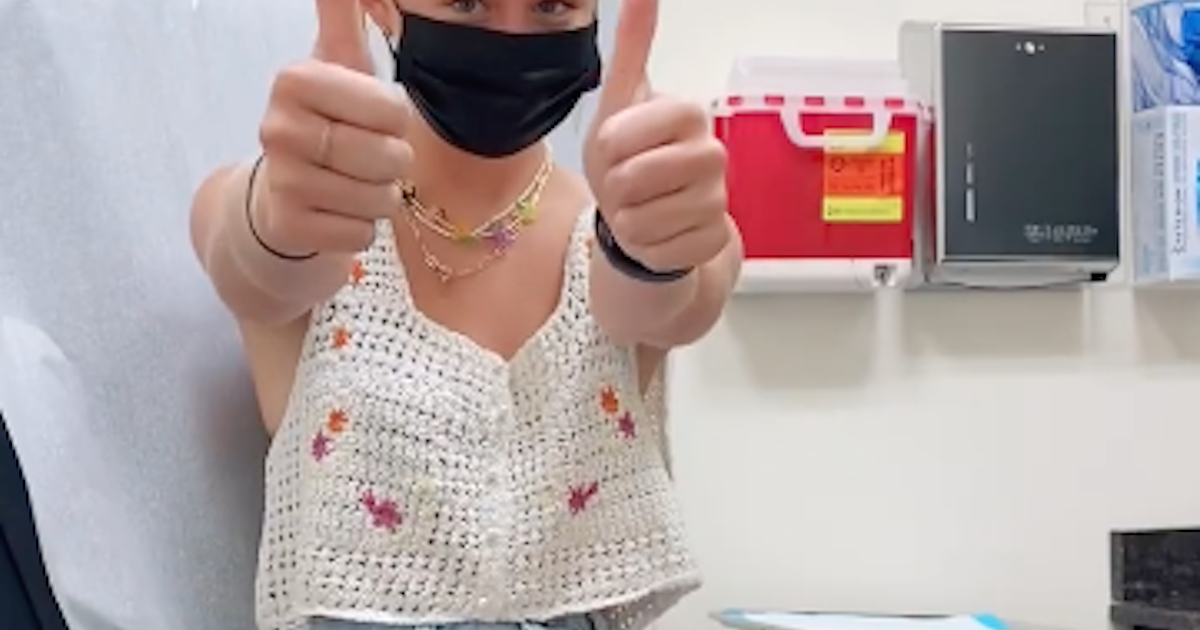
'Anne With an E' Stars Shares Details From her Second Round of Chemo
- Miranda McKeon said she was “sad” and “afraid” as she was going through her second round of chemotherapy in her breast cancer battle
- “I've had a sore throat for a week and a half. I just want to swallow again. I was feeling so fragile,” she wrote, later noting: “I’m so scared to lose my hair.”
- The chances of a teenager being diagnosed with breast cancer are one in a million
“Keeping it real. My morning was absolute shit,” McKeon wrote at the start of her lengthy Instagram post.
Read More“I don't want to feel sick again for another week. I haven't felt truly sad since I wrote my last post on grieving about a month ago. I've felt like I should feel sad but honestly I've been extremely happy recently. But this morning I felt sad to the core.”
The Anne With an E star was not too sad to give thanks, however, and did share her gratitude list for the week. Among those she thanked were her friends for making her a 25-minute video, Frank Ocean and her parents.
She also made a point of closing on a high note, and adopted a much more hopeful tone.
“Excited for the chemo to kill more cancer today. Feeling optimistic for this afternoon. LFG!!!!!!” wrote Miranda.
View this post on Instagram
McKeon said in a recent interview that she is trying to find the “beauty” in her stage III breast cancer, while her mother recounted how devastating those first appointments were after her daughter’s diagnosis.
Jill McKeon said that reality sank in almost immediately when they met with doctors, who at some point began to discuss her daughter’s fertility.
“That was gutting,” Jill said in an interview with People. “I said to the doctor, ‘We’ll talk about that later, this is already enough information.’ She was like, ‘Actually, we’re talking about this because we have to.’ ”
A week later, Miranda was injecting herself with hormones so she could undergo the procedure before chemotherapy.
Miranda will now have four months of chemotherapy to target the stage III breast cancer which has spread to her lymph nodes.
Through that point, Miranda had remained nothing but positive.
“It’s a safety net,” she said of freezing her eggs. “I’ll probably be able to have kids naturally on my own, and hopefully they’ll just be donated to science in however many years, but we’ll see.”
What’s more, she is trying to see only the good in a situation that is so statistically rare that most in her position would deem it unfair or a cruel fate.
“I’m making it my job to find the beauty in all of this,” said Miranda. “I wouldn’t have chosen this, I didn’t choose this, I don’t think anyone would choose this. But I’m making it my job to try and pull something out of this.”
Miranda has said that writing and sharing her story has also helped her get through these difficult times
She admitted that the Instagram posts she shares are also a good substitute on those days when journaling is too difficult.
It was just one month ago that Miranda announced that she was one of the rare teenagers to get diagnosed with breast cancer.
“Pink is my new color!!!!! It is with a heavy yet hopeful heart that I share news that I was recently diagnosed with breast cancer,” wrote Miranda at the time.
“I am 19 and as statistics go- the chances of having breast cancer at this age are one in a million! (literally, look it up on Google) I am so special- but we knew this💛!”
View this post on Instagram
Miranda said that she was traveling to San Francisco where she was planning to spend a few weeks working on a sustainable farm when she got a call about a biopsy she had done a week prior. She had just touched down in California at the time, but 90 minutes later was back on a plane heading home so she could undergo more tests.
Related: Angelina Jolie Details Her Grief Over Cancer Loss
The actress said that she was showered with love from her family and friends the next few days before learning that the lump she felt was indeed cancer.
“So the long and short of it is – I am embarking on a journey that is not of my choosing, but one I know I can handle,” wrote Miranda.
“There will be really difficult times ahead when life feels impossible. But for now, I am headed into this with optimism, positivity, and surrounded by love.”
Miranda hasn’t detailed her treatment plan, but did say last week that it would involve surgery, chemotherapy and radiation. She also made a point of telling her young followers not to feel sad for her or worry they too might have cancer, accurately pointing out that only four percent of those who are diagnosed with breast cancer every year are under the age of 40.
Getting a Mammogram
Women aged 45 to 54 should have annual mammograms; women with a history of breast cancer in their family should begin screening even earlier. Dr. Connie Lehman, the chief of the Breast Imaging Division at Massachusetts General Hospital, emphasizes in an earlier interview how mammograms save lives. She says, "If you haven't gone through menopause yet, I think it's very important that you have a mammogram every year. We know that cancers grow more rapidly in our younger patients, and having that annual mammogram can be lifesaving."
Related: When You're Getting a Mammogram, Ask About Dense Breasts
"After menopause, it may be perfectly acceptable to reduce that frequency to every two years," says Dr. Lehman. "But what I'm most concerned about is the women who haven't been in for a mammogram for two, three, or four years, those women that have never had a mammogram. We all agree regular screening mammography saves lives."
When Should I Get a Mammogram?
Doing a Self-Exam at Home
In addition to regular mammogram screenings, women should also do self-exams at home. The American Cancer Society (ACS), says, “Women should be familiar with how their breasts normally look and feel and should report any changes to a health care provider right away.”
Related: You Should Be Aware of These Signs of Breast Cancer
The National Breast Cancer Foundation says here’s how to do a self-exam at home:
- While standing straight in front of a mirror, place your hands on your hips and look at your breasts for any swelling, bulging, changes in the shape of breast or nipple (inverted), redness, rashes, or any fluid leaking. Then do the same with your arms in the air.
- Next, while lying down, use your right hand to examine your left breast and vice versa, while using your first three fingers to apply pressure. Ensure you cover the entire breast area, from your collarbone to below your ribcage and from your armpit to your cleavage area. Do the same self-exam standing or sitting up. Be sure to use light to medium pressure for the middle breast area and firmer pressure when feeling deep breast tissue.
Getting to Know Your Breasts with Self-Exams
Learn more about SurvivorNet's rigorous medical review process.


