
Understanding Ovarian Cancer
- Teacher’s assistant Cathy Brockhoff is sharing her story after a stage 3 ovarian cancer diagnosis at 47, urging women not to ignore persistent stomach pain and other subtle symptoms.
- It’s important to note that ovarian cancer is often diagnosed at an advanced stage. In fact, it has been called “the sleeping lion,” Dr. Kimberly Resnick, gynecologic oncologist at MetroHealth in Cleveland, Ohio, previously told SurvivorNet. “It’s hard, because 75% of women who walk into our office with ovarian cancer, unfortunately, are going to walk in with advanced stage disease.”
- In fact, if a woman doesn’t have any symptoms and is not at high risk for a hereditary ovarian cancer syndrome, current recommendations say that she should not get screened. This is an across the board consensus from major medical groups and public health organizations such as the U.S. Preventive Services Task Force, the American College of Obstetricians and Gynecologists, and the American Cancer Society.
- Screening of women who are at an average risk for the disease may do more harm than good, as it can lead to more testing or even unnecessary surgery. However, it is recommended that women who are at a high risk for ovarian cancer due to an inherited genetic syndrome consider getting screened.
- If you or someone you love is navigating cancer, you don’t have to face every question alone. SurvivorNet’s My Health Questions, an AI-powered tool, can help you find answers to everyday cancer questions, better understand treatment options, and feel more informed along the way.
Sharing her story with News 12 Long Island, Brockhoff revealed she woke up on Easter morning in 2023 with a stomach ache she likened to indigestion. When the pain persisted, she went to the hospital. Further testing and and a sonogram ultimately revealed she had a mass on her ovary.
Read More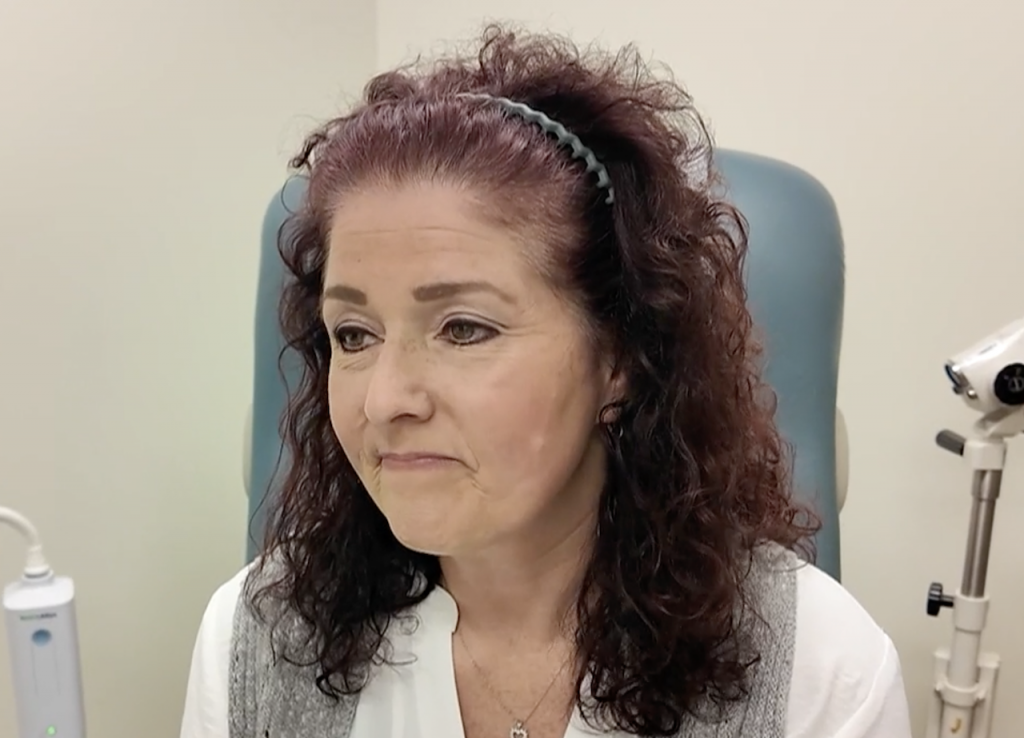
Further sharing her story with TODAY.com, she admitted, the diagnosis “literally came out of the blue,” calling it “very crazy.”
She continued, “I still process it when someone says to me, ‘ovarian cancer.’ Like it still makes your stomach drop, even though it’s three years later. Because I’m still like, wow, that’s me. That’s still surreal.”
Brockhoff’s gynecologic oncologist, Dr. Antoinette Sakaris of Northwell South Shore University Hospital, also spoke with TODAY.com, noting that Brockhoff is “definitely on the younger side” for an ovarian cancer diagnosis. That, she said, is exactly why “her story is actually quite important to bring to the public.”
“So that women hopefully can be more in tune with looking for subtle symptoms of ovarian cancer,” Dr. Sakaris.
Expert Ovarian Cancer Resources
- 3 Common Myths About Ovarian Cancer Screening
- ‘We Expect to Put About 80% of Our Ovarian Cancer Patients into Remission’
- ‘An Important Step Forward’: New Drug Combo Shows Promise For The Treatment of Some Ovarian Cancer
- Ovarian Cancer Symptoms Can Be Hard to Spot
- Ovarian Cancer: Symptoms, Diagnosis & Making a Treatment Plan
- A Targeted Ovarian Cancer Treatment– The Role of Avastin (Bevacizumab)
- Advances in Ovarian Cancer Treatment
- Can I Still Have Sex During Ovarian Cancer Treatment?
Understanding The Stages and Grades of Ovarian Cancer
Brockhoff never expected an ovarian cancer diagnosis — she had no family history of the disease and no genetic mutations known to raise the risk of developing it.
In an effort to encourage others to get checked, she told TODAY.com, “Working and raising kids, we don’t always take the time out to realize, ‘I’ve had this stomach ache for four days.’
“I feel like we constantly make excuses or push things [off] because we’re always going forward in another direction. We have to stop doing that.”
Understanding Ovarian Cancer.
Ovarian cancer often begins in the fallopian tubes, where abnormal cells can migrate to the ovaries and form tumors. Dr. Beth Karlan, a gynecologic oncologist at UCLA Medical Center, previously told SurvivorNet, “There are different kinds of ovarian cancer that affect women at different stages of life. The most common type of ovarian cancer, however, typically occurs around the time of the menopause.”
It’s important to note that there is no screening test for ovarian cancer, but doctors say it is important for women to be aware of symptoms which can indicate something is wrong.
The signs of ovarian cancer can include:
- Feeling bloated or full
- Pain in the pelvis or abdomen
- Nausea
- Vomiting
- Changes in bowel habits
“We don’t have a good screening method, but if you have symptoms, it’s very important that you go to your physician because there might be an opportunity that we can detect it when it’s still early stage,” Dr. Jose Alejandro Rauh-Hain, a gynecologic oncologist at MD Anderson Cancer Center, previously told SurvivorNet.
“It’s very important that patients are not afraid to ask questions to their physicians. Because the sooner we can diagnose the cancer, the better that prognosis.”
Ovarian Cancer: What Are The Symptoms And Warning Signs?
It’s important to note that ovarian cancer is often diagnosed at an advanced stage. In fact, it has been called “the sleeping lion,” Dr. Kimberly Resnick, gynecologic oncologist at MetroHealth in Cleveland, Ohio, previously told SurvivorNet. “It’s hard, because 75% of women who walk into our office with ovarian cancer, unfortunately, are going to walk in with advanced stage disease.”
RELATED: Ovarian Cancer Symptoms Can Be Hard to Spot
Unlike some other types of cancer, such as breast cancer and colon cancer, there aren’t any routine screening tests for ovarian cancer. At the present time, there are no simple and reliable methods available that can screen for ovarian cancer in women who do not have any signs or symptoms. “We don’t have an inexpensive, easily reproducible test that we can use to prevent this disease,” says Dr. Resnick.
In fact, if a woman doesn’t have any symptoms and is not at high risk for a hereditary ovarian cancer syndrome, current recommendations say that she should not get screened. This is an across the board consensus from major medical groups and public health organizations such as the U.S. Preventive Services Task Force, the American College of Obstetricians and Gynecologists, and the American Cancer Society.
Screening of women who are at an average risk for the disease may do more harm than good, as it can lead to more testing or even unnecessary surgery. However, it is recommended that women who are at a high risk for ovarian cancer due to an inherited genetic syndrome consider getting screened.
There are tests that doctors use when they suspect a patient might have ovarian cancer, and for those who have a genetic predisposition to this cancer. These include the transvaginal ultrasound, which is an ultrasound of the female genital organs that is done internally, and a blood test called CA-125, which tests for a marker that is elevated in women with ovarian cancer. However, these are not true screening tests for ovarian cancer.
“These are tests we may use in a patient in whom we have a high suspicion of cancer, or in patients who have a genetic predisposition to the disease,” said Dr. Resnick. “But these are not screening tests to use in everyday women who walk into the office with abdominal cramps.”
Treating Ovarian Cancer
The standard of care for ovarian cancer patients is chemotherapy, which helps many patients reach remission.
WATCH: How your ovarian cancer responds to certain types of chemotherapies guides your future treatments.
With recurrence a strong possibility for this disease, especially in the later stages of ovarian cancer, certain drug treatments to deal with it are giving many women hope.
Maintenance therapy is continued treatment after the patient finishes their initial treatment. After an ovarian cancer patient completes a round of treatments — such as surgery and chemotherapy — her doctor may recommend some form of maintenance therapy to try and delay possible recurrence. Maintenance therapy can involve taking an oral pill called a PARP inhibitor every day after chemotherapy and can keep cancer in remission longer.
Genetic testing helps doctors determine the best maintenance therapy.
Genetic testing—analyzing a patient’s DNA or biopsy tissue—can reveal critical insights about cancer: how it forms, how it behaves, and how best to treat it.
“There are certain cancer-causing genes that can be passed down from generation to generation,” said Dr. Derrick Haslem, the director of medical oncology at Intermountain Healthcare in Salt Lake City, in an earlier interview with SurvivorNet.
As researchers uncover more about these inherited mutations, they’re not only pinpointing who might be most at risk—they’re also refining how cancers are detected and treated.
When it comes to ovarian cancer, this information is especially vital.
WATCH: What genetic testing reveals about your cancer?
“There are a lot of mutations that put people at a higher risk for ovarian cancer,” says Dr. Haslem. That’s why your medical team asks about your family history—because genetic red flags can run in families. “If you have a family history of ovarian cancer or breast cancer, that’s a really important thing to bring up with your healthcare provider.”
Mutations in the BRCA1 and BRCA2 genes are among the most common genetic links to ovarian cancer. Another factor, homologous recombination deficiency (HRD), can occur in women with BRCA mutations and further disrupts the cells’ ability to repair their DNA.
If you do have a strong family history, your doctor may recommend testing for BRCA mutations or other inherited syndromes like Lynch syndrome, which can also increase risk for ovarian, colorectal, and breast cancers.
Sometimes, testing positive for a high-risk mutation may lead to conversations about preventive steps. “If you were tested and you had that gene, then somebody might talk to you about prophylactic surgery to remove the ovaries and fallopian tubes,” says Dr. Haslem. This kind of preventive surgery can significantly reduce future cancer risk in those genetically predisposed.
Beyond risk assessment, genetic findings also guide treatment. “Certain chemotherapies and targeted therapies are much more effective in those types of cases,” Dr. Haslem adds. For example, PARP inhibitors—designed to block DNA repair in cancer cells—have shown strong results in patients with BRCA mutations and HRD.
Ultimately, genetic testing isn’t just about knowing your risk—it’s a tool that helps tailor treatment and potentially saves lives.
WATCH: Clinical trials can be life-saving.
Why Self-Advocacy in Healthcare Can Be Life-Saving
When patients actively advocate for their health, it can lead to earlier diagnoses, broader treatment options, and ultimately better outcomes—especially when initial symptoms are overlooked or dismissed.
Part of this advocacy means not settling for a single medical opinion. Persistence matters: revisiting your doctor, pushing for answers, and seeking additional perspectives from other healthcare providers can be crucial steps in the journey.
WATCH: The value of getting a second opinion
Getting another opinion may also help you avoid doctor biases. For example, some surgeons own radiation treatment centers. “So there may be a conflict of interest if you present to a surgeon who is recommending radiation because there is some ownership of that type of facility,” Dr. Jim Hu, director of robotic surgery at Weill Cornell Medical Center, tells SurvivorNet.
Other reasons to get a second opinion include:
- To see a doctor who has more experience treating your type of cancer
- You have a rare type of cancer
- There are several ways to treat your cancer
- You feel like your doctor isn’t listening to you, or isn’t giving you sound advice
- You have trouble understanding your doctor
- You don’t like the treatment your doctor is recommending, or you’re worried about its possible side effects
- Your insurance company wants you to get another medical opinion
- Your cancer isn’t improving on your current treatment
WATCH: The Importance Of Getting A Second Opinion: Tara Lessard Shares Her Cancer Story.
Questions for Your Doctor
If you’ve been diagnosed with ovarian cancer and are looking for ways to better understand your disease and treatment options, here are some key questions to bring to your doctor.
You can also turn to SurvivorNet’s proprietary AI tool, “My Health Questions,” which helps patients and caregivers navigate a new diagnosis and prepare thoughtful, personalized questions for their care team.
- What type of ovarian cancer do I have?
- What stage is my cancer in?
- Do you recommend I get genetic testing for any gene mutations, such as the BRCA gene mutation?
- What initial treatment options do you recommend?
- What are the possible side effects of the recommended treatment, and how can they be coped with?
- Will insurance help cover my recommended treatment?
WATCH: A New Wave of Cancer Patients Using SurvivorNet’s My Health AI Tools For Support
Contributing: SurvivorNet Staff
Learn more about SurvivorNet's rigorous medical review process.
