Coping with Ovarian Cancer & a Diagnosis As a Mom
- Randee Johnson, a mom of three from Anchorage, Alaska, was diagnosed with late-stage ovarian cancer and tested positive for the BRCA-1 gene after months of feeling unwell. She ultimately underwent emergency ovarian cancer debulking surgery, chemotherapy, a hysterectomy, and preventative mastectomy.
- Ovarian cancer is often harder to catch in its early stages because of its subtle symptoms, such as bloating, weight gain, and abdominal pain that can mimic regular menstrual cycle fluctuations. After ovarian cancer patients complete initial treatment, maintenance therapy may be recommended to try and delay possible recurrence.
- BRCA1 and BRCA2 genes are inherited mutations that increase the risk of several kinds of cancer, including breast and ovarian cancer.
- Anyone battling cancer may find telling their children about their diagnosis to be a really difficult task. You want to be honest with them and you want them to be prepared for what might happen, but at the same time you want to protect them, and be as gentle as possible.
- “Having these conversations may bring up deep emotions you may have stowed away. There is nothing wrong with showing our emotions to children as long as we can remain calm and give them a sense of safety,” Licensed clinical psychologist Dr. Marianna Strongin said.
During a recent interview, according to Your Alaska Link TV, Johnson, who is BRCA1 positive, and had a heightened risk of developing cancer, explained how how she “just hadn’t been feeling good” before her diagnosis.
Read More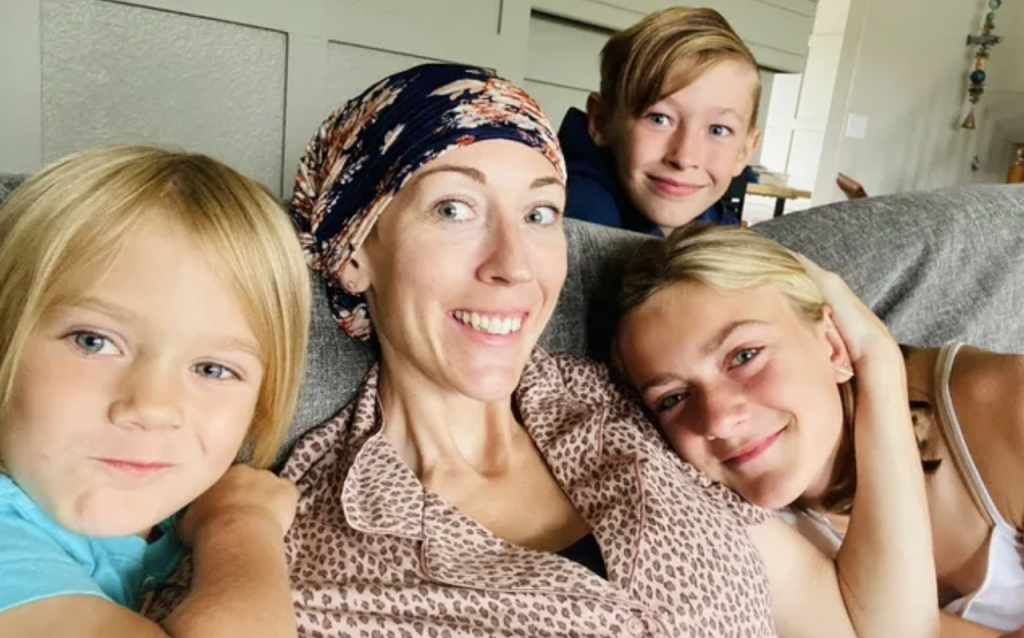
“Randee was first diagnosed with advanced ovarian cancer on the 4th of July weekend. She hit the battlefield forcefully just three days after being face with her opponent.
“Randee underwent a major surgery to kill off any large cancer growths that set up camp inside her abdomen. Five pounds of her opponents were demolished from various parts inside her small and large intestine, liver, stomach wall, bowel and more.”
The crowdfunding page also revealed Johnson underwent a full hysterectomy and five months of chemotherapy.
During an interview with Northwell Health, Johnson discussed how she first learned she had the BRCA1 (BReast CAncer gene 1) gene, meaning she had a heightened risk for cancers like ovarian and breast cancer.
RELATE: What You Need to Know About BRCA1 and BRCA2 Genes
She told Northwell Health, “I found out I was BRCA11 positive at some point in the haze of my 10-day hospital stay after having emergency ovarian cancer debulking surgery.
“I didn’t really educate myself on BRCA, or what that meant to have BRCA, until I was kind of through the haze of that surgery and on my path into chemo, which was like two weeks after surgery.”
She ultimately decided to undergo a nipple-sparing mastectomy in Long Island, New York, to lower her breast cancer risk.
While the steps in treating ovarian cancer are tailored to fit everyone’s unique disease characteristics, most patients will undergo surgery at some point during the course of their treatment. The only difference is at what point during treatment does the surgery take place – before or after chemotherapy. Debulking surgery is a procedure that aims to remove as much of the cancer as possible, with the goal of improving one’s overall outcome.
“Many women with newly diagnosed ovarian cancer will be offered a primary debulking surgery,” says Dr. Adam ElNaggar, gynecologic oncologist at the West Cancer Center in Memphis, Tennessee.
“That is the initial step towards treating the ovarian cancer.” Primary debulking surgery is when the surgery is given as the first treatment after an ovarian cancer diagnosis. The most common alternative is neoadjuvant chemotherapy, in which the first treatment is instead chemotherapy.
Debulking Surgery for Ovarian Cancer: What to Expect
Debulking surgery is performed by an GYN or surgical oncologist, who operates directly within the body to physically remove the cancer. According to Dr. ElNaggar, open surgery, versus a minimally invasive approach, usually involves making a vertical incision down the middle of the belly, “with the goal of removing all the disease that can be seen with the naked eye.”
The cancer is removed from anywhere that it’s visible in the abdomen. “That will of course include the uterus, the cervix, the fallopian tubes, the ovaries,” says Dr. ElNaggar. Other areas might also be affected, including the lymph nodes, the omentum (a “fatty apron” that hangs over the stomach), the spleen, and the gallbladder.
Surgery may also include a bowel resection if the cancer has spread to the small or large intestine. A bowel resection involves removing and then reconnecting part of the intestine, after which the patient may need to have an ostomy bag to collect waste until their bowel heals.
After the surgery is complete, patients are placed into one of three categories, depending on how much of the cancerous tissue was successfully removed.
The three categories are:
- Suboptimal cytoreductive surgery: Patient still has tumors larger than 1 centimeter in the abdomen
- Optimal surgery: Any disease that is left in the abdomen measures less than 1 centimeter
- No gross residual disease: No disease can be seen in the abdomen
Patients with optimal surgery or no residual disease tend to have a better prognosis following surgery than those who have more cancer left behind. However, even if the patient is categorized as “optimal” or “no gross residual disease,” this does not mean that the cancer is completely gone. “It takes about a million cancer cells to be the size of a tip of a pen,” says Dr. ElNaggar.
“So while I can’t see any cancer, we know that it’s there, and therefore the next step to curative therapy is to give chemotherapy after the surgery.”
Ovarian Cancer: What To Know
It’s unclear how old Johnson was at the time of her diagnosis, but it’s important to understand that according to the American Cancer Society, it is rare in people younger than 40, as it usually occurs in people after menopause. Half of all ovarian cancers diagnosed are in people older then 63.
With ovarian cancer, chemotherapy is usually the first stage of treatment, but staging the cancer is a little more difficult until your doctor performs a surgery.
Expert Ovarian Cancer Resources
- 11 Ovarian Cancer Tests Used for Patient Diagnosis
- 3 Common Myths About Ovarian Cancer Screening
- A Comprehensive Guide to an Advanced Form of Ovarian Cancer Known as ‘Folate Receptor-Alpha Positive’
- A Promising New “Go-To” Treatment for Women Just Diagnosed With Ovarian Cancer — PARP Inhibitors Show Benefit For All
- Advances in Ovarian Cancer Treatment
- An Ovarian Cancer Drug That Cuts Tumor Growth
- Administering Chemotherapy for Ovarian Cancer
- Birth Control and Ovarian Cancer – Can It Reduce the Risks of Aggressive Ovarian Cancer?
- Can I Still Have Sex During Ovarian Cancer Treatment?
- Can a Pap Smear Detect Ovarian Cancer?
- Chemo or Surgery: Deciding The Order For Ovarian Cancer Treatment
Gynecologic oncologists often recommend a staging procedure when they have evidence that the cancer may be early or limited, which has to do with the location of the tumor. Based on where the cancer is found, it will be assigned a stage.
“If it’s remained in the ovary where it was initially found or developed, then the cancer is Stage 1,” says Dr. Amanda Fader, vice chair of gynecologic surgical operations at Johns Hopkins University in Baltimore, told SurvivorNet.
How Do I Know The Stage of My Ovarian Cancer? Staging Surgery Determines Spread
“But if the cancer has started to spread to other organs or through the lymph nodes to other parts of the body, then it would be identified as Stage 2, 3, or 4,” Dr. Fader added.
The Stages of Ovarian Cancer
As Dr. Fader mentioned, the stages of ovarian cancer depend on if the cancer has spread elsewhere into the body, and how far.
- Stage 1: The cancer is confined to the ovaries or fallopian tubes
- Stage 2: The tumor involves one or both ovaries with extension to other pelvic tissues (or is a primary peritoneal cancer)
- Stage 3: The cancer has spread outside of the pelvic peritoneum including to the outside of the bowel, liver and spleen and/or it involves the lymph nodes
- Stage 4: There are distant metastases (outside of the pelvis and abdomen) or metastases to the inside of the spleen or liver
When doctors have evidence before the surgery, such as from imaging tests, that the tumor may be limited to the ovary, they will usually recommend a staging procedure. During that operation, doctors remove all or part of the ovary with the tumor and send it, while the patient is still asleep on the operating table, to a pathologist who will examine the tissue and identify the type of tumor so doctors can decide how best to treat it.
If the tumor is determined to be benign, the surgery can end. Otherwise, more extensive surgery is usually performed.
Prior to the surgery the patient and her doctor would have discussed the various possible findings, so that depending on the result of the ovarian biopsy, the surgeon knows what the patient’s wishes are and how to proceed. “We would have made these decisions ahead of time through our preoperative counseling,” explained Dr. Fader.
Understanding Symptoms of Ovarian Cancer
There is no screening test for ovarian cancer, but doctors say it is important for women to be aware of symptoms which can indicate something is wrong.
The signs of ovarian cancer can include:
- Feeling bloated or full
- Pain in the pelvis or abdomen
- Nausea
- Vomiting
- Changes in bowel habits
As we all know, many of these can be similar to symptoms many women experience monthly with their menstrual cycle.
“We don’t have a good screening method, but if you have symptoms, it’s very important that you go to your physician because there might be an opportunity that we can detect it when it’s still early stage,” Dr. Jose Alejandro Rauh-Hain, a gynecologic oncologist at MD Anderson Cancer Center, told SurvivorNet.
“It’s very important that patients are not afraid to ask questions to their physicians. Because the sooner we can diagnose the cancer, the better that prognosis.”
Ovarian Cancer: What Are The Symptoms And Warning Signs?
What If You Have the BRCA Gene Mutation?
If you discover that you do have a mutation, there are options available to manage your cancer risk, which includes enhanced screenings; prophylactic (risk-reducing) surgery, which involves removing as much of the “at-risk” tissue as possible; and chemoprevention, the use of medicines to reduce the risk of cancer.
WATCH: Understanding the BRCA Gene Mutation
If you do discover you have ovarian cancer, it actually can be advantageous to have a BRCA mutation, as long as you are being treated with a PARP inhibitor, a drug therapy that was developed and approved by the FDA beginning in 2014. PARP inhibitors work by blocking the protein PARP from repairing the damaged DNA that can lead to cancer. These inhibitors kill the dangerous cells but leave the healthy ones intact, which is exactly what you want to happen.
“The PARP inhibitor prevents the repair of the (damaged) single-strand DNA break, and your BRCA mutation prevents the repair of the double-strand DNA break,” Dr. Rebecca Arend, Associate Scientist at the University of Alabama, Birmingham, explains to SurvivorNet.
What to Consider When Weighing Preventive Mastectomy?
A prophylactic, or preventative, mastectomy is an operation where the breast tissue is removed to prevent cancer from developing in the future.
“Risk-reducing mastectomies are an operation where we take women at, usually, very high-risk for getting breast cancer for genetic mutation carriers, who are the ones at the highest risk; there’s unfortunately only one way to actually prevent breast cancer,” Dr. Elisa Port, Chief of Breast Surgery at Mount Sinai Health System, tells SurvivorNet.
WATCH: What to Consider When Thinking About a Mastectomy
“Women who are found to test positive for a genetic mutation really have two options,” Dr. Port explains. “One is what’s called high-risk surveillance, which means we check them every six months or so mammograms, MRIs with the hope that if God forbid, they develop breast cancer, we pick it up early. But that’s not prevention; it’s early detection.
“Early detection is a goal; it’s not a guarantee. For the woman who wants to be more proactive about actually preventing breast cancer, or as we say reducing her risk, unfortunately, the only way to do that is to remove the actual tissue at risk, and that is the breast tissue,” she adds.
Some women decide to have their breasts reconstructed and have implants put in right after the mastectomy, while others don’t have reconstruction at all.
The benefits of a prophylactic or preventative surgery are:
- Significant reduction in cancer risk (from 80-90% to 1-2%)
- Nipples can often be spared
- Women can get reconstruction at the same time
Battling Cancer as a Parent
Opening up about cancer diagnosis with children can be really difficult task. You want to be honest with them and you want them to be prepared for what might happen, but at the same time you want to protect them, and be as gentle as possible.
John Duberstein, who lost his wife Nina to cancer, explains that he and his wife tried to take a progressive approach and be as open with their kids as possible. But as honest as they were, they ran into some issues with their kids understanding the disease. When Nina started to look healthier, for example, the kids assumed she was getting better, but that wasn’t the case.
Talking to Kids About Cancer: Be Open as Much as You Can
“It was a real eye-opening moment for two people who felt like they were dealing really head-on with this stuff, talking to the kids,” Duberstein told SurvivorNet in an earlier interview.
“So I think it’s important to be open with the kids as much as you can, as much as you feel like they can handle. But it’s also important to revisit it and not make assumptions. At the end of the night, what Nina had to tell them was, ‘I’m not ever going to get better. My cancer is not ever going to go away,’ it was hard for them to hear even though they’d already been prepared.”
Meanwhile, breast cancer survivor Gina de Givenchy previously spoke with SurvivorNet about going through cancer treatment as the mother of a 12-year-old girl.
“I felt it was important to mask it because I really wanted her to know that I was going to be OK. I didn’t want her to see me weak and sickly,” she said. “When it comes to your kids, I think you always want to sort of protect them.”
Telling Your Kids You Have Cancer ‘When it Comes to Your Kids, You Want to Protect Them’
The pressures of parenthood can be daunting during a cancer journey, but having little ones that depend on you can also provide another source of motivation to fight for your life.
Jovannie Lorenzo also knows this to be true. When she was diagnosed with colon cancer at 32, she felt an immense amount of fear because she was a single parent of her three kids. Going into her cancer battle, Lorenzo knew she would do everything in her power to be around to raise them.
“I knew that I had to do everything possible to be here for my children,” Lorenzo told SurvivorNet. “They are my saving grace. They are the reason I wake up every morning. They are the reason why I fight every single day and I make a choice to be positive, to be happy, and to move forward.”
Facing a Cancer Diagnosis as a Single Parent: “I Knew I Had to Fight for My Life”
Obviously, not every parent feels comfortable sharing so much about their diagnosis with their children. Some survivors have even told us that they were afraid to tell their family members, but as for Duberstein, de Givenchy, and Lorenzo, honesty was the best policy.
Licensed clinical psychologist Dr. Marianna Strongin encourages people with sick parents “to talk about your feelings with your immediate family as well as your parents.” She’s previously talked about the importance of expressing your feelings in her advice column for SurvivorNet.
“Talking about difficult things does not cause more anxiety,” Dr. Strongin said. “It is NOT talking about the very thing that we are all afraid or worried about that causes our body to feel dysregulated (unable to manage emotional responses or keep them within an acceptable range of typical emotional reactions) and anxious.”
Specifically, with patients who may be scared to talk to their children about a diagnosis, Strongin said children can pick up on their emotions, so it may help to check in with yourself beforehand.
“Having these conversations may bring up deep emotions you may have stowed away. There is nothing wrong with showing our emotions to children as long as we can remain calm and give them a sense of safety,” Dr. Strongin said.
Contributing: SurvivorNet Staff
Learn more about SurvivorNet's rigorous medical review process.