
Refusing to Let Cancer Define Your Future
- NYC marathoner and mom of two, Tatiana Simon, has completed five marathons since her breast cancer diagnosis at age 36, continuing to run through chemotherapy, multiple surgeries, radiation, and a recurrence while balancing treatment and parenting young children.
- A self-discovered lump led to Simon’s diagnosis of early-stage invasive ductal carcinoma, an ER-positive, HER2-negative breast cancer. Genetic testing was negative, but after discussions with her care team and an elevated Oncotype DX score, she chose a double mastectomy (removal of both breasts) followed by chemotherapy.
- “There is no one direct line for treating breast cancer … what is right for one person may not be the same answer for the next person,” said Dr. Sharon Rosenbaum Smith of Northwell Health, highlighting how Simon’s care was tailored around her marathon schedule and personal goals through a shared decision-making approach.
- Despite undergoing a double mastectomy, Simon later experienced a small recurrence that she detected herself while training for the Tokyo Marathon, underscoring the importance of self-awareness and follow-up care.
- The recurrence was caught early, surgically removed, and followed by radiation treatment coordinated around her continued running.
Since being diagnosed with breast cancer at age 36, Simon has undergone chemotherapy, multiple surgeries, radiation treatment, and even treatment for a recurrence. Through it all, she has continued running, completing five marathons after her diagnosis and refusing to let cancer define her future.
Read More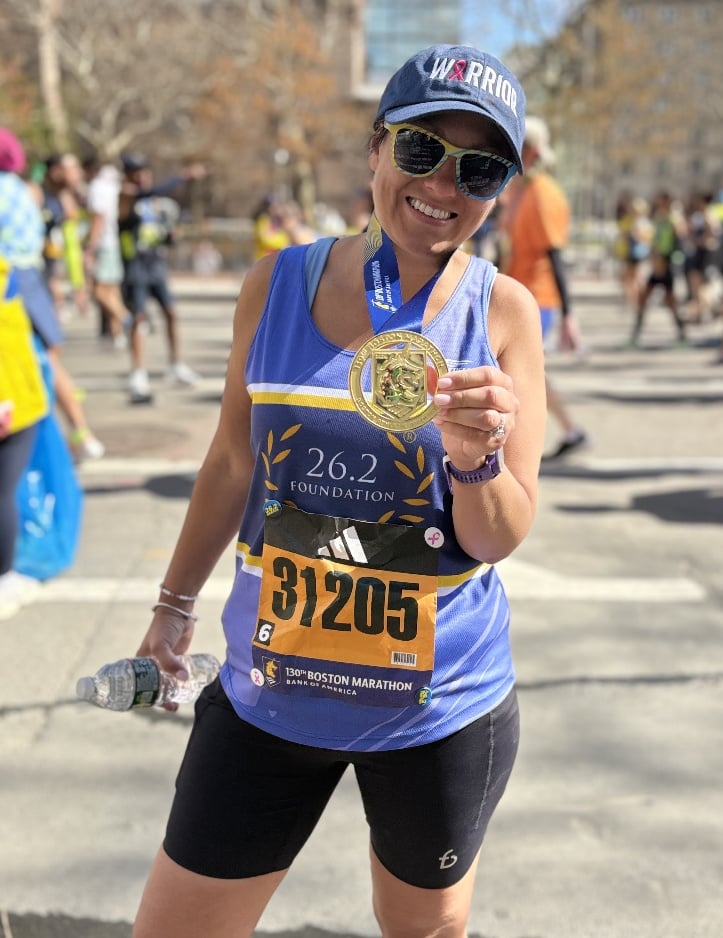 Her journey, alongside the care she received from breast surgeon Dr. Sharon Rosenbaum Smith, associate chief of breast surgery at Northwell Health’s Lenox Hill Hospital, highlights the importance of individualized treatment, self-advocacy, and maintaining the parts of life that matter most during cancer care.
A Lump That Changed Everything
“The story has to start with you knowing your body, taking findings seriously, and doing self-examination,” Dr. Rosenbaum Smith tells SurvivorNet.“She noticed the lump, she was sent for imaging, and she had a biopsy done, and it came back as positive for cancer.”
At just 36 years old, Simon was younger than the age when routine breast cancer screening typically begins for women at average risk. Testing revealed she had invasive ductal carcinoma, estrogen receptor-positive, HER2-negative breast cancer with negative lymph nodes.
According to research from Penn Medicine, hormone receptors are proteins on breast cells that respond to estrogen and progesterone signals, which can fuel cancer growth. Breast cancers that contain receptors for either hormone are known as hormone receptor-positive (HR+) cancers.
These tumors may be estrogen receptor-positive (ER+), progesterone receptor-positive (PR+), or both. About 70% to 80% of breast cancers are HR+, and most of those are ER+, PR+ or both. An ER+ cancer grows in response to estrogen, while a PR+ cancer responds to progesterone. Identifying a tumor’s hormone receptor status helps guide treatment because therapies can be designed to block the hormones that drive tumor growth. Hormone receptor-positive disease can occur across all stages and types of breast cancer.
HER2 stands for human epidermal growth factor receptor 2. It’s a protein that helps breast cancer cells grow quickly. Patients with HER2-positive tumors have tumors that show HER2 overexpression, while patients with HER2-negative tumors show minimal or no expression.
Simon also received genetic testing because of her young age at diagnosis.
“It’s very important when we have women who are either young with a cancer diagnosis or have a significant family history to do genetic testing,” Dr. Rosenbaum Smith explains. Although Simon tested negative for a known gene mutation, she ultimately chose to undergo a bilateral mastectomy (also called a double mastectomy, which removes both breasts) after discussing her treatment options with her care team.
“After a long discussion, she did elect to undergo a bilateral mastectomy, not only to remove the breast that had the cancer in it, but to prophylactically remove the other breast to decrease her risk of a future breast cancer,” Dr. Rosenbaum Smith says.
An Oncotype DX test later returned an elevated score, helping guide the decision to proceed with chemotherapy.
WATCH: What is the Oncotype DX Test and Do I Need it?
Treating the Whole Person, Not Just the Cancer
For many patients, a cancer diagnosis can place life on hold. However, Simon wasn’t interested in abandoning something that had been central to her identity for decades.
“Running was always a part of me. I’ve been doing it since I was like 12 years old,” Simon told SurvivorNet.
The thought of losing that ability was deeply upsetting.
“That would have been devastating to me, doing something that I’ve been doing for so long. I felt like cancer took so much from me, and then to take that on top of it.”
Rather than asking Simon to put her life aside, her medical team incorporated it into her treatment plan.
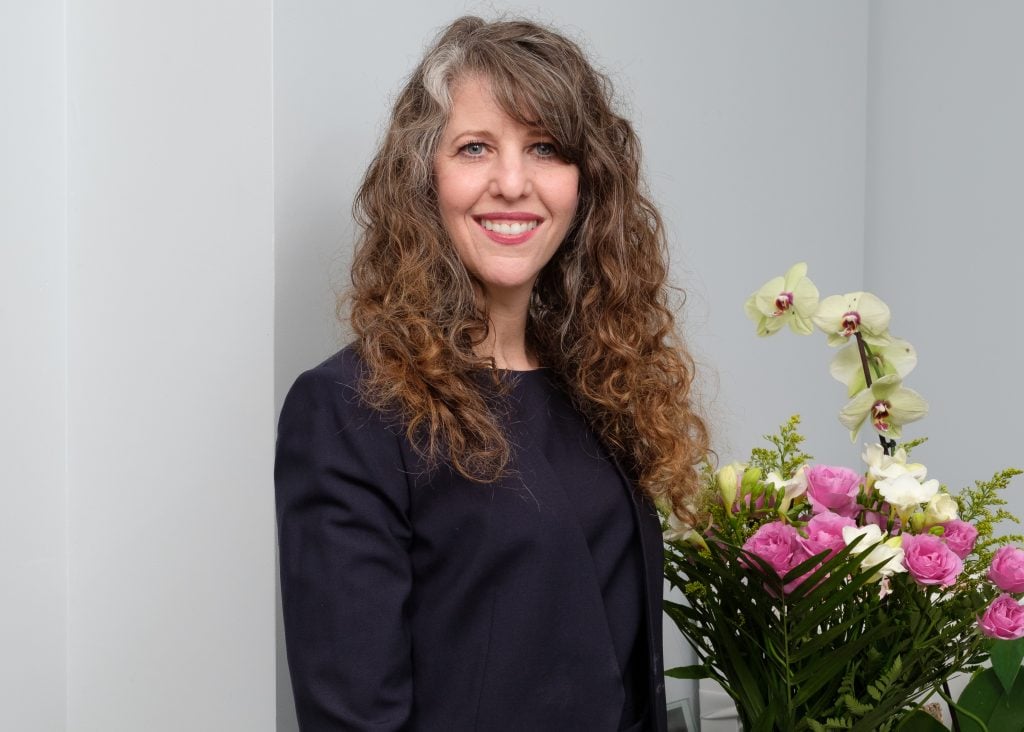
“After coordinating care and seeing the plastic surgeon and working it out with her busy life and busy schedule and other marathons she was scheduled to run, we actually elected to do the surgery the day after she was running a marathon,” Dr. Rosenbaum Smith says.
She views this shared decision-making approach as critical to modern cancer care.
“There is no one direct line for treating breast cancer,” she says.
“There’s no one right answer. So what is right for one person may not be the same answer for the next person. I think finding what the right answer for the individual person is so important because I’m expecting all my patients to live a very long life afterward.”
For Dr. Rosenbaum Smith, treatment planning extends beyond the disease itself to encompass a patient’s personal goals, lifestyle, and future plans.
“Tailoring the care to the people” is essential, she says, noting that issues such as fertility, family planning, work responsibilities, and quality of life should all be part of treatment discussions.
WATCH: Can I Have A Baby After Breast Cancer?
Running Through Treatment
Continuing to run during chemotherapy, surgery recovery, and radiation was not easy.
“There were days I did not feel good, and there were days I felt great. I would take it day by day,” Simon recalls.
During treatment, she was also caring for a one- and two-year-old.
“Thank God my husband was very supportive, so if I wanted to go out on a walk, I’d go out on a walk. If I could start incorporating a two-minute run and a one-minute walk, I would do intervals like that, and I just kept going.”
Managing Side Effects Became a Matter of Adaptation
“Chemo, I kind of learned after the first round to keep up with my nausea medicine,” Simon says. “Once I was able to take my nausea meds… that’s what worked for me.”
She also relied on simple dietary adjustments, including salty foods, to help manage nausea.
The first week of chemotherapy is typically the most challenging, but patients tend to feel less fatigued during the second and third weeks. Whether patients can work generally depends on their job type and level of exertion required.
“That second and third week, their energy levels are much better,” Dr. Scott Rushing with Compass Oncology explains to SurvivorNet.
“Most patients are not going to be able to work at full strength during that first week after getting chemo, especially if they have a job that requires exertion. That is going to be a little difficult. So it just depends on the type of job that my patient has whether they can work selectively during that time,” Dr. Rushing continued.
Radiation Brought Its Own Challenges.
“I dealt with severe radiation burns afterward where my skin ended up actually opening,” Simon says.
Still determined to continue moving, she worked with her physician to find solutions.
“My doctor at that time didn’t even tell me to stop. He said, ‘Let’s come up with a solution.’ I cut up a cotton T-shirt and put it underneath my sports bra, and he gave me some antibiotics, and we just went.”
Radiation therapy is often used after surgery to destroy any remaining cancer cells in the breast or surrounding tissue. As radiation oncologist Dr. Subhakar Mutyala told SurvivorNet, “Radiation therapy is actually ionizing energy, where energy goes through your body, essentially causes DNA damage… The actual treatment is just ionizing energy.”
WATCH: The Debates Around Radiation for Breast Cancer
While radiation is a standard part of care for many, experts continue to debate its scope and necessity. Dr. Chirag Shah of the Cleveland Clinic Cancer Center notes two key controversies: whether to use whole breast versus partial breast radiation, and whether some patients may not need radiation at all.
“The idea is reducing the duration of treatment and reducing side effects for patients,” Dr. Shah said. “Omitting radiation is therefore associated with a lower risk of side effects.”
Simon believes staying active made a meaningful difference.
“[Running] also helped me during chemo, with the nausea and stuff,” she says. “Getting the fresh air, getting the movement in… it helps. It helps so much.”
Her experience aligns with research that has increasingly demonstrated benefits of physical activity for cancer patients.
“Exercise both before cancer diagnosis and during cancer diagnosis actually improves a person’s survival,” Dr. Rosenbaum Smith says. “So all these things she is doing actually is wonderful for her as a person and for her breast cancer survival.”
Finding Strength as a Mother
While running helped Simon cope physically and emotionally, motherhood became her deepest source of motivation.
When she first received her diagnosis, her children were babies.
“You kind of forget at the moment what you’re going through because the kids are so young. They need you,” she says.
One memory remains especially vivid from the moment Simon learned she had cancer.
“I remember holding the baby, and I was so scared that I wasn’t going to be here. I remember holding him and just smelling him, and I was like, ‘God, if this is it, just don’t let me ever forget his smell.'”
The fear of leaving her children behind became added fuel to keep pushing forward.
“I knew that they were my why,” Simon says.
She also credits her husband with helping her manage the uncertainty.
“My husband’s a very different personality than me. He was like, ‘Just one step at a time. That’s it. Don’t think ahead.'”
The Unexpected Recurrence
After completing surgery, chemotherapy, reconstruction, and recovery, Simon believed the hardest chapter was behind her.
She had chosen a double mastectomy in part because she hoped to minimize the possibility of facing breast cancer again.
WATCH: What Happens During a Double Mastectomy?
“I never wanted to go through the MRIs, the biopsies again,” she says.
Yet while preparing to run the Tokyo Marathon, she felt something concerning.
“I kept feeling my breast because they say you’ve got to watch the scarring, and I felt this little lump.”
Despite having undergone a double mastectomy and achieving clear margins, testing confirmed a small recurrence.
“I screamed into that pillow like nobody’s business,” she recalls. “I was angry. I was probably more scared the second time around. I felt so much self-doubt, like, what did I do wrong?”
Dr. Rosenbaum Smith says Simon once again trusted her instincts.
“She noticed a lump in the chest wall again. And again, she knows her body. She knows the changes that occur. And she took it seriously.”
They detected the recurrence early and removed it successfully.
“We were able to remove it. It was tiny,” Dr. Rosenbaum Smith says.
Dr. Rosenbaum Smith explains that recurrence can happen even after mastectomy because microscopic breast cells can remain behind.
“When you’re doing a mastectomy, you are not removing 100% of the breast cells. You can’t. There can always be a microscopic cell left there, and then that cell decides it wants to turn into a malignancy.”
Following surgery, Simon underwent radiation treatment, once again coordinating care around marathon goals.
“We tailored this around her marathons,” Dr. Rosenbaum Smith says.
One of Simon’s most emotional moments came at the Boston Marathon, which she ran the day before her double mastectomy.
“I was trying to just control the moment that I had,” she says. “When I crossed that finish line, more tears were shed.”
Running gave her something cancer could not take away.
“I wanted to show people that even with what I was going through, we can control the things we have in front of us at that moment.”
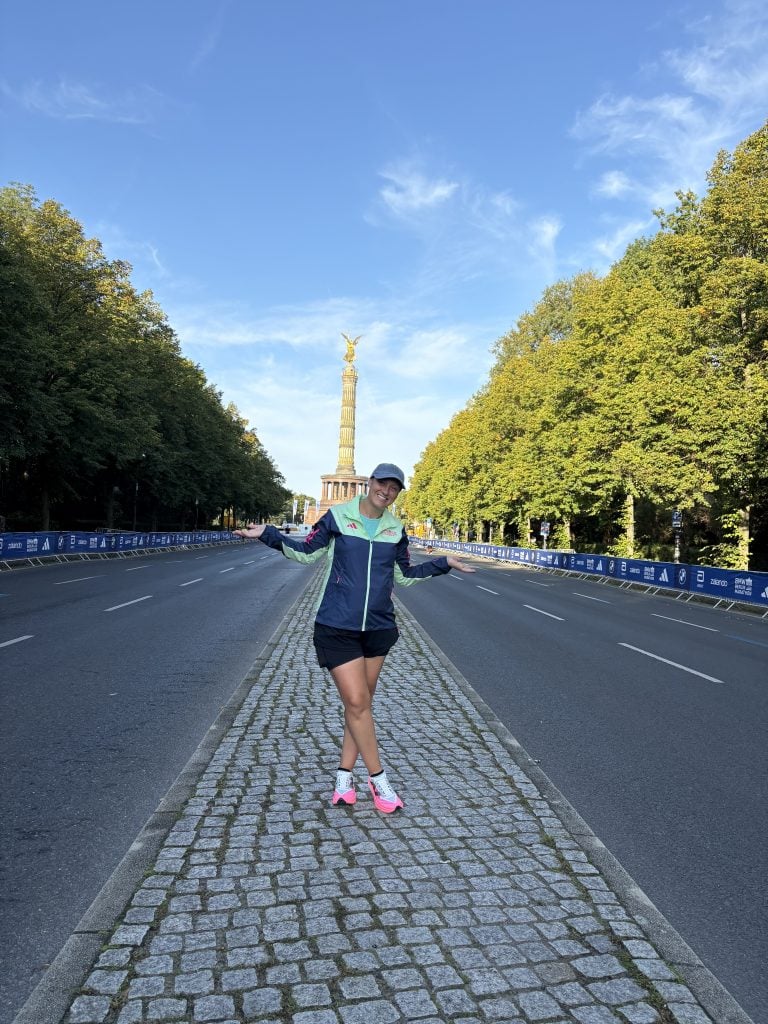
That mentality remained with her. One month after chemotherapy, she chose to run the Berlin Marathon despite being underprepared.
“I probably had no business running that marathon at all,” she says. “I was so sick afterward.”
Still, she finished.
“The biggest thing is just to put one foot in front of the other. Just keep going. Don’t give up.”
Simon is still undergoing treatment, and yet she managed to run in the New York City marathon.
To Dr. Rosenbaum Smith, Simon represents something remarkable.
“Sometimes we hear people who get diagnosed with a cancer, and then they get inspired to do things. To me, this is even better. This is her life. Nothing slowed her down.”
“She was going to keep doing what she did. She was going to keep doing what she loved, and we were going to tailor our treatment around her life, and we were able to successfully do that.”
Learn more about SurvivorNet's rigorous medical review process.


