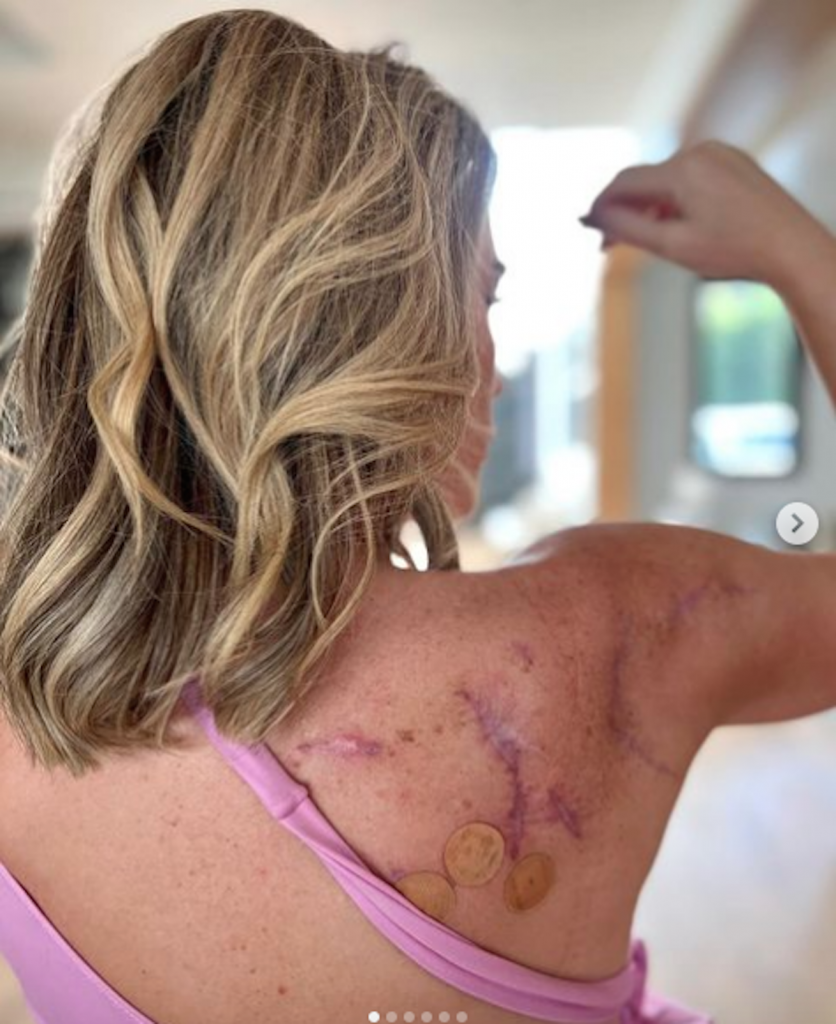
“Housewives” star Teddi Mellencamp, 44, found a moment of joy in her stage 4 melanoma journey after trying on a new wig, offering a boost of confidence following brain surgery to remove tumors that spread to her brain and ongoing immunotherapy treatment.
Diagnosed in 2022, Teddi has undergone multiple biopsies and surgeries for the aggressive skin cancer, which is known for its ability to spread throughout the body.
Her latest treatment included immunotherapy, a major advancement in melanoma care that activates the immune system to attack cancer cells, though it can contribute to cognitive side effects like “chemo brain.”
Experts like Dr. Nima Gharavi, Director of Dermatologic Surgery at Cedars-Sinai, note that while immunotherapy has transformed melanoma treatment, surgery—often with wide margins or Mohs surgery for early, surface-level cases—remains the cornerstone of care.
“Real Housewives of Beverly Hills” alum Teddi Mellencamp, 44, found a rare moment of joy in her years-long battle with advanced melanoma, an aggressive form of skin cancer, when she tried on a new wig and saw a glimpse of herself she feared she’d lost.
“I’m so happy,” she said in an Instagram video from the salon. “I love it so much!”
Earlier this year, Mellencamp revealed that her stage 4 melanoma had spread to her brain, leading to memory issues and requiring brain surgery to remove tumors.
Melanoma begins in the pigment‑producing cells of the skin, and unlike other skin cancers, it can mutate in ways that allow it to spread to distant organs — including the brain. While often found on sun‑exposed areas, melanoma can also appear on the palms, soles, eyes, mouth, or under the nails.
BEVERLY HILLS, CALIFORNIA – MAY 20: Teddi Mellencamp Arroyave attends the Alliance for Women in Media Foundation’s 50th Annual Gracie Awards at the Beverly Wilshire, a Four Seasons Hotel on May 20, 2025, in Beverly Hills, California. (Photo by Presley Ann/Getty Images for Alliance for Women in Media Foundation)
In addition to surgery, Mellencamp has undergone immunotherapy, a treatment that activates the body’s immune system to attack cancer cells.
“Immunotherapy is a very important weapon in the fight against melanoma,” said Dr. Janice Mehnert of NYU Langone’s Perlmutter Cancer Center.
Throughout treatment, the mother of three has worn a short hairstyle after shaving her head, which is a difficult but common step for many cancer patients.
WATCH: Coping With Losing Your Hair During Chemo
Hair loss can be a major emotional hurdle, often tied to identity and self‑esteem.
“To see a bald head is really, really difficult for most of us,” says Laurie Ostacher, a medical social worker at Sutter Bay Medical Foundation. “Our classic image of a cancer patient is someone who does not have any hair.”
Photo: Instagram/thewigfairy
Mellencamp’s new wig, however, offered comfort and confidence she didn’t expect.
“Oh my gosh, this looks so much better,” she said with a smile. “It actually looks like it’s coming out of my head!”
Coping with Hair Loss in Cancer Care: Practical Advice & Emotional Support
Hair loss can be one of the more emotionally challenging parts of a cancer journey. For many patients, it’s not just about appearance—it’s about identity, control, and coping with change. SurvivorNet offers guidance and resources to help you navigate this side effect with confidence and care.
“For cancer patients, losing one’s hair can be unbelievably stressful. The dread alone can lead to sleepless nights and heightened anxiety,” says Dr. Samantha Boardman, a New York-based psychiatrist and author.
WATCH: What is a scalp-cooling device?
While chemotherapy is a common cause of hair loss, radiation can also lead to thinning or baldness—especially when the treatment area includes the scalp. For instance, radiation targeting a brain tumor may result in hair loss on the head.
The good news? Hair typically begins to regrow within four to six weeks after treatment ends. According to Dr. James Taylor, a radiation oncologist at GenesisCare, “Fortunately, for most patients, hair loss is not a concern when having radiation therapy.” Still, regrowth may come with changes in texture or color.
If hair loss is a concern, know that you have options—from wigs and wraps to hats and scarves—that can help you feel more like yourself during treatment.
Understanding Scalp Cooling Devices
Cold cap during infusions to help protect hair follicles. Scalp-cooling devices have been approved by the FDA recently, first for breast cancer and then for several other cancers.
That means wearing cold caps or special cooling caps before, during, and after each chemotherapy treatment.
The caps, which are tightly fitting and strap-on helmet-style, are filled with a gel coolant that’s chilled to between -15 and -40 degrees Fahrenheit.
Essentially, the caps “cause vasoconstriction, or a narrowing of the blood vessels bringing blood to the scalp,” Dr. Renata Urban, gynecologic oncologist at the University of Washington, explains.
By constricting the blood flow to the scalp, the caps limit the circulating chemotherapy that reaches the hair follicles, protecting them from some of the chemo’s damaging effects.
The cold also decreases the activity of the hair follicles, which slows down cell division and makes the follicles less affected by the chemotherapy medicine.
WATCH: What is a scalp-cooling device?
Dr. Julie Nangia, a medical oncologist at Baylor College of Medicine and a lead author on one of the major studies of the device, says 50% of women were able to keep their hair after four rounds of chemotherapy, and added: “Without the devices, 100% of patients lost their hair.”
There have been some safety questions when it comes to scalp-cooling, but Dr. Nangia says that when given to people with solid tumors (like breast, ovarian, colon, and lung cancer), the devices are safe.
Teddi’s Ongoing Cancer Journey
As we noted earlier, Mellencamp has undergone several biopsies and surgeries for her skin cancer. When it spread to her brain, the gravity of her diagnosis grew stronger.
“She has 10 lesions in her brain … even though the lesions are not cancerous right now, they still interrupt her thinking, and it’s in her frontal lobe,” John Mellencamp, Teddi’s father, told People Magazine.
(@teddimellencamp/Instagram)
In November, Teddi shared a hopeful update: her scans showed “no detectable cancer.”
“At this point, there is no detectable cancer,” she told RadarOnline. But her father emphasized that the journey is far from over. “That doesn’t mean she’s home free… she has to keep on this treatment for who knows how many years,” he said.
Teddi has been undergoing immunotherapy, a treatment often described as a “living drug” because it retrains the body’s own immune system to attack cancer cells. While it has been effective, she has been candid about the toll it takes.
Courtesy of Instagram/@teddimellencamp
“Some days are definitely better than others,” she said.
“You don’t see all the times I’m lying in my bed, unable to do much. Don’t be afraid to let people know how you’re feeling, and don’t feel guilty if you need to rest.”
A clinical trial studying the impact of high-risk melanoma patients using the immunotherapy agent pembrolizumab (brand name: Keytruda), used before and after surgery, reduces the risk of tumor recurrence.
The group treated in the trial before and after surgery saw a 42% lower rate of cancer‑related “events,” such as the cancer returning.
@teddimellencamp
“It’s important that patients and physicians are aware of this study as it represents a new potential standard of care,” Dr. Mehnert said.
“For patients with high-risk disease, delivering immunotherapy prior to surgery must be considered.”
Dermatologist Dr. Cecilia Larocca of Dana-Farber Cancer Institute told SurvivorNet that immunotherapy transformed melanoma care.
WATCH: The Side Effects of Immunotherapy.
“When immunotherapy came on the market, it was such an exciting time for everyone involved in the care of melanoma… it went from this scary, unmanageable cancer with no treatments to one that could potentially have a long-lasting result,” explainedDr. Cecilia Larocca, dermatologist at Dana-Farber Cancer Institute, in an interview with SurvivorNet.
Still, side effects are common and can include fatigue, nausea, joint pain, and changes in blood counts. In rare cases, patients may experience severe reactions that require stopping treatment.
Although other forms of treatment, including immunotherapy, are treatment options depending on the patient’s specific diagnosis, Dr. Nima Gharavi, Director of Dermatologic Surgery at Cedars-Sinai, says, “The gold standard for treatment of melanoma is surgical treatment with wide margins.”
In some cases of early-stage melanoma that’s close to the skin’s surface, Mohs surgery may be offered. This is most common in areas such as the face, ears, and nose.
Mohs Micrographic Surgery: A Precise Approach to Skin Cancer Treatment
Mohs surgery is the leading method for treating skin cancer on delicate, high-risk areas like the face, ears, and nose. This meticulous technique—known as Mohs micrographic surgery (MMS)—uses microscopic guidance to remove cancerous tissue layer by layer, ensuring that only affected areas are excised while preserving as much healthy skin as possible.
WATCH: The best surgery option for melanoma.
During the procedure, the area is numbed with a local anesthetic. The surgeon carefully removes the visible tumor with a scalpel and immediately examines the tissue under a microscope. If cancer cells remain, the process is repeated—one layer at a time—until all cancerous cells are gone.
This methodical approach offers high cure rates, particularly when cancers are caught early, and minimizes scarring for sensitive, visible areas of the body.
“What is being done is that you’re able to remove a very conservative margin around the cancer and study it in, essentially, real time,” explains Dr. Sumaira Aasi, a professor of dermatology and Director of Mohs and Dermatologic Surgery at Stanford.
“The Mohs surgeon will take a conservative cut circumferentially around the cancer, where we’re able to preserve healthy tissue. We’re able to process the tissue and look at the cancerous tissue and know where there are still tumor cells persisting. As the Mohs surgeon removes the cancer, it’s mapped out.”
Dr. Aasi adds that the surgeon may go back specifically to the areas where the cancer cells were present and take out another conservative margin or amount of cancerous tissue, and repeat the process until the cancer is out completely.
Immunotherapy Side Effects During Treatment for Melanoma
A new study published in JAMA Oncology is shedding light on the long-term side effects of immunotherapy in melanoma patients—revealing that chronic complications may be more widespread than previously thought.
“Chronic and long-lasting side effects were more common than we expected and involved a variety of often overlooked organs like the thyroid, salivary glands, and joints,” said Dr. Douglas Johnson, senior author of the study and associate professor of medicine at Vanderbilt University Medical Center.
WATCH: Tell Your Doctor About Immunotherapy Side Effects
Despite the findings, Dr. Johnson emphasized the groundbreaking nature of immunotherapy, especially anti-PD-1 drugs. “It has been an absolute game-changer for patients with melanoma,” he noted. “I think the first thing to recognize is how really transformative the Anti-PD-1 drugs have been… patients can have very long-term responses to treatment.”
Still, for patients with advanced melanoma—especially those who’ve undergone surgical removal and have a low risk of recurrence—Dr. Johnson advised more nuanced conversations around treatment. “So determining whether the risks of the side effects, weighing the benefits of treatment with the risks of the side effects, can be an important consideration,” he said. “What our study did was we basically saw that some of these side effects were more common, really, than had been previously reported.”
Reported side effects can range from mild to severe, including dry throat, inflammation of the eye blood vessels, numbness, or tingling. And for many, the decision comes down to weighing symptom severity with potential longevity benefits.
WATCH: Managing Immunotherapy side effects.
Dr. Anna Pavlick, another expert in melanoma care, added context around immunotherapy management. “Depending upon the severity, it depends upon how we manage it,” she said.
“The percentage of patients who have very serious side effects from immunotherapy is contingent upon whether patients will get one medicine or a combination of two medicines.”
She explained that patients receiving a single immunotherapy drug face a 10–15% chance of experiencing severe reactions like rash or diarrhea. But for patients with metastatic melanoma, a dual-drug regimen—though more effective at controlling the cancer—comes with about a 50% chance of developing side effects.
FDA-Approved Immunotherapy for Melanoma
There are several FDA-approved immunotherapies for melanoma. Each is approved for certain instances of melanoma.
Tebentafusp-tebn (Kimmtrak)
Aldesleukin (Proleukin)
Atezolizumab (Tecentriq)
Dostarlimab (Jemperli)
Interferon alfa-2b (Intron A)
Ipilimumab (Yervoy)
Nivolumab (Opdivo)
Peginterferon alfa-2b (Sylatron/PEG-Intron)
Pembrolizumab (Keytruda)
Talimogene laherparepvec (Imlygic)
Imiquimod (Aldara)
The goal is to steadily reduce the risk of recurrence in all patients. It’s not a one-size-fits-all approach. Some people may not be candidates for this therapy, and side effects vary from person to person.
Understanding Melanomas
Melanoma starts in the same cells that give your skin, hair, and eyes their color. In melanoma, the cells change in a way that allows them to spread to other organs.
Changes to a mole you’ve had for a while or a new growth on your skin could be signs of melanoma, according to SurvivorNet’s experts. You’ll want to watch them and tell your doctor about any changes you notice.
WATCH: How do you perform a skin check using the ABCDEs?
SurvivorNet experts recommend avoiding unprotected sun exposure because ultraviolet (UV) radiation can lead to melanoma. Tanning beds pose ultraviolet radiation risks for skin cancer and should be avoided. Many dermatologists recommend using spray tans to reduce the risk of melanoma skin cancer.
The most important thing to look out for when it comes to finding melanoma is a new spot on your skin or a spot that is changing in size, shape, or color, SurvivorNet’s medical experts say.
Treatment options for melanoma include targeted therapy and immunotherapy, which give people a better chance of living a long and healthy life than ever before. If you’re diagnosed with melanoma, there’s a good chance surgery will be the treatment your doctor recommends.
Cancer removal usually leads to a cure in the early stages of the disease. After surgery, the removed tissue and lymph nodes are examined to measure the melanoma and determine if it has clear margins. Clear margins mean the cells around the area of tissue that was removed don’t contain any melanoma. When no cancer cells are left around the removed area, your cancer is less likely to return.
WATCH: Beating Aggressive Melanoma: An Immunotherapy Success Story
For melanoma patients who need additional treatment after surgery, they are likely to receive adjuvant therapy (treatments administered after surgery). Adjuvant therapy is designed to improve outcomes and decrease the risk of recurrence.
Questions to Ask Your Doctor
If you are diagnosed with skin cancer, you may have some questions for your doctor. SurvivorNet suggests the following to help you on your cancer journey.
What type of skin cancer do I have?
What treatment options exist for my type of melanoma?
Will insurance cover this treatment?
Would treatment through a clinical trial make sense for me?
What resources exist to help manage my anxiety because of this diagnosis?
Kavontae Smalls is a writer and reporter for SurvivorNet. Read More
Later Stage Melanoma
There have been many developments in recent years when it comes to treating melanoma, but there is no one-size-fits-all approach to this disease. Doctors have a handful of tools to choose from, and many factors will go into determining your treatment.