
Understanding Stage Zero Breast Cancer (DCIS)
- Fox News host Kat Timpf, 37, is heading into her first holiday season without her father, Daniel, who died unexpectedly in May at 69 from an aortic dissection, a tear in the inner layer of the body’s largest artery that can be rapidly fatal without prompt treatment.
- Speaking on Fox News’ podcast the Girls, Timpf said she has no regrets about prioritizing time with her dad and urged others to “put up with the annoyance” because time with loved ones isn’t guaranteed.
- Timpf, who is pregnant with her second child, underwent a double mastectomy for stage zero breast cancer (DCIS) after being diagnosed hours before giving birth to her first child in 2025.
- DCIS is non-invasive and highly treatable, though doctors continue to debate how aggressively to treat low-risk cases.
“Thought I had a lot more time with him, but one thing that I don’t have is regret that I didn’t prioritize my father,” Timpf, 37, said on Fox News’ podcast the Girls, which launched Oct. 1.
Read MoreTimpf, who co-hosts the podcast with Fox News anchor Harris Faulkner, “Fox & Friends Weekend” co-host Rachel Campos-Duffy, and Fox News contributors Melissa DeRosa and Kaylee McGhee White, said she is “still very much dealing with the shock” of her father’s death.View this post on Instagram
“My dad was so healthy. It can really happen to anyone,” she said. “And I heard other people say that all the time. And I never really, I still didn’t think it would happen to me. And it did.”
The television personality, comedian and author knows that kind of shock firsthand. After welcoming her first child, she underwent a double mastectomy for stage zero breast cancer, also known as ductal carcinoma in situ (DCIS). With DCIS, abnormal cells form in the lining of the breast’s milk ducts, the tubes that carry milk to the nipple during breastfeeding. Because those cells haven’t spread into the surrounding breast tissue, DCIS is considered non-invasive and is often highly treatable.
Now, as she prepares to grow her family again, Timpf hopes her loss can serve as a wake-up call for others.
“Your parents are your parents. So they’re always going to have these quirks. They’re always going to be annoying. And you might disagree on some stuff. You might even fight,” she said.
“But I would just encourage anyone to push those things aside, barring serious stuff, of course.”
She acknowledged that there can be valid reasons some people choose not to speak with their families, but stressed that time is not guaranteed.
“You don’t have unlimited time and you don’t know,” Timpf said. “So I would just encourage people to, you know, put up with the inconvenience, put up with the annoyance… because you really, one day it’s over. When it’s over, it’s over. And I never could talk to my dad again.”
Expert Resources On Coping With Emotions
- SN & You Presents Mental Health: Coping With Emotions
- 7 Simple Tips People With Cancer Can Do To Care For Their Mental Health and Manage Stress
- How Can Genetic Testing Help Determine the Right Form of Mental Health Treatment?
- Mental Health and Cancer — The Fight, Flight or Freeze Response
- Mental Health: A Guided Breathing Exercise to Help Manage Anxiety
- Mental Health: Coping With Feelings of Anger
- Mental Health: Understanding the Three Wellsprings of Vitality
- How to Be Realistically Optimistic: Coping With Mental Health Long-Term
- How to Handle the Emotional Toll of Caring for a Loved One: Prioritizing Your Mental Health
Timpf previously opened up about her loss in a Father’s Day tribute shared to Facebook in June, alongside a photo of her dad. She recalled a trip to Charlevoix, Mich., two years earlier, when she and her husband told her father she was pregnant with his first grandchild.
“If someone then had told me then that, the following year, I would begin a less-than-14-month stretch of horror in which I’d lose my breasts, my cat, and my father — let alone that my dad would die unexpectedly in the exact town where we were now celebrating, I likely would have said the exact same thing so many people say to me now: that I couldn’t imagine,” she wrote.
“But, as anyone who has been hit with tragedy knows, your previous ability to imagine something actually has no bearing on whether or not it does.”
She closed the post with a candid message to her late father.
“Miss you every day, Dad. I know I’m supposed to button this up with some kind of expression of gratitude to make other people feel more comfortable,” she wrote.
“But instead I’ll be honest: Although I’m SO grateful to have had my father as my dad, I also know that the world is and always will be a worse place without him in it.”
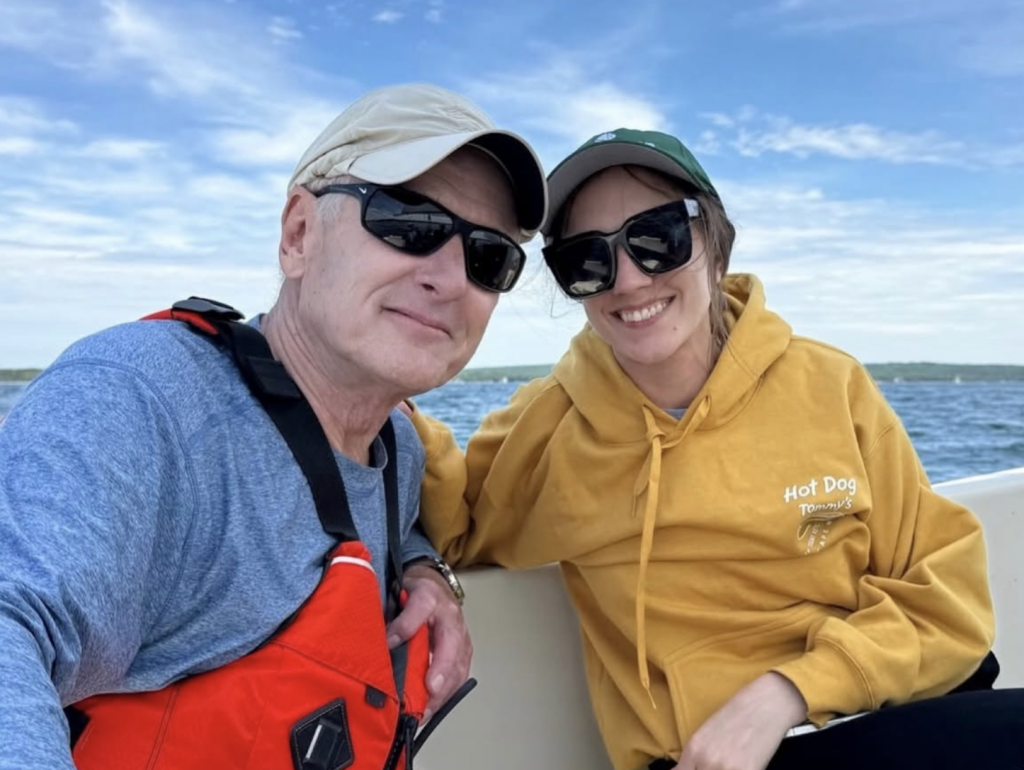
Her father, Daniel “Dad Timpf” Timpf, died unexpectedly on the evening of May 7, 2026, at 69.
“He was very fit. He would not drink out of a plastic water bottle,” Timpf said. “When he died, he was going up north for a day of sailing.”
According to Timpf, who opened up about his death on the premiere episode of the Girls, she had spoken to him the morning he died. She later learned from a doctor she had never met that he had suffered an aortic dissection after initially going to the hospital with a stomach ache. An aortic dissection is a tear in the inner layer of the aorta, the body’s largest artery. Blood surges through the tear, causing the layers of the aortic wall to separate, according to the American Heart Association. It is a medical emergency that can be rapidly fatal if not diagnosed and treated promptly.
In a July statement from the American Heart Association, issued after Sen. Lindsey Graham’s sudden death was linked to an aortic dissection, Dr. Manesh Patel, the AHA’s volunteer president and chief of the division of cardiology at Duke University School of Medicine, noted that the condition is more common in men than women and affects an estimated 5 to 30 people per million.
Dr. Patel advised that people with risk factors such as high blood pressure, tobacco use, or a family history of aortic aneurysms or dissections talk with their doctors about their risk and screening.
Kat Timpf’s Breast Cancer Journey
In March 2025, just weeks after her diagnosis, Timpf shared a photo of herself outside Memorial Sloan Kettering Cancer Center in NYC, captioning it with a rundown of every medical hurdle still standing between her and the gym.
“Once I recover from childbirth, my mole removal scars heal, I get a double mastectomy, get rid of my cancer, have breast reconstruction surgery & am physically capable of getting back in the gym it’s OVER FOR U,” she wrote on Instagram.
That post followed her February 2025 announcement, which she dubbed “unconventional.” In it, Timpf shared that she had just become a mom, and that she’d learned she had breast cancer roughly 15 hours before her labor began.
“Now, before you worry, my doctor says it’s Stage 0 and is confident that it almost certainly hasn’t spread,” she wrote on X and Instagram. “Or, as I’ve explained to the few people I’ve managed to tell about it so far: Don’t freak out. It’s just, like, a LITTLE bit of cancer.”
View this post on Instagram
She admitted the day was anything but calm. “Still, it was not a chill day,” she wrote. “I woke up more-than-a-week-past-due pregnant, completely consumed by doing everything I could to get the baby out.”
Hours later, the focus had shifted from delivering her baby to treating her cancer, as she shuffled between doctor’s appointments. “I sat and listened as they told me that the best course of action would likely be a double mastectomy as soon as possible,” she recalled.
Understanding Kat Timpf’s Early-Stage Breast Cancer
Stage zero breast cancer, or ductal carcinoma in situ (DCIS), is made up of abnormal cells that line a duct in the breast. A normal breast contains many ducts that carry milk to the nipple in a lactating woman. DCIS is not invasive, meaning it has not spread outside the milk duct into other parts of the breast.
WATCH: I Have Stage Zero Breast Cancer: What Should I Do?
SurvivorNet experts say that if DCIS is left untreated, it may develop into a more advanced breast cancer. Dr. Ann Partridge, an oncologist at Dana-Farber Cancer Institute and the founder and director of the Program for Young Adults with Breast Cancer, has told SurvivorNet that DCIS is “a pre-cancer, technically.”
She explained that stage zero breast cancer is “something that may turn into invasive breast cancer. Invasive breast cancer is the kind of breast cancer that has the potential to not only grow in your breast but to spread to other places in the body and ultimately hurt someone more than just needing a breast surgery.”
The current standard of care for DCIS is surgery, either a lumpectomy or mastectomy, sometimes followed by radiation and hormone therapy. The good news is that the outlook is excellent: according to the Breast Cancer Research Foundation, women with stage zero breast cancer have a 98 percent survival rate after 10 years.
The Debate Over Treating Low-Risk DCIS
How aggressively to treat DCIS remains one of the big debates in breast cancer care, and a major 2024 study added new evidence.
The COMET trial compared active monitoring, meaning breast imaging and exams every six months, with standard treatment of surgery with or without radiation. The trial enrolled women 40 and older with low-risk, hormone receptor-positive grade 1 or 2 DCIS. Results were presented at the San Antonio Breast Cancer Symposium in December 2024 and published in JAMA.
After two years, the risk of developing invasive breast cancer was nearly the same in both groups: 4.2 percent with active monitoring and 5.9 percent with standard care. A separate analysis published in JAMA Oncology found that women under active monitoring reported similar physical, emotional and psychological outcomes to those who had upfront treatment.
Still, the findings come with important caveats. Researchers acknowledged that more invasive cancers may show up with longer follow-up, particularly in the monitoring group, and further analyses are planned at 5, 7 and 10 years. The women in the trial were also much older than Timpf, with a median age of about 64, and treatment decisions depend on the specifics of each patient’s diagnosis.
“But I think if a woman is seeing a physician who says you need surgery, I think it’s really important that she maybe get a little more information,” Dr. Partridge said.
Dr. Chirag Shah, director of breast radiation oncology at the Cleveland Clinic Cancer Center, says recent studies show the risk of dying from stage zero breast cancer is very low, which has led some doctors to consider less aggressive treatment. But he cautions that monitoring alone isn’t yet standard practice.
“Protocols, such as the COMET trial, are studying the use of surveillance regimens, but this is not standard of care and is experimental at this time, and active surveillance is not something that we would recommend for patients outside of a clinical study,” Dr. Shah said.
Finding a Balance Between Screening and Treating
Dr. Alana Welm of the Huntsman Cancer Institute has told SurvivorNet that doctors need to strike a balance between screening and identifying cancers that actually require treatment.
Screening leads to more cancer diagnoses, and some of those cancers may never have caused a problem. Dr. Welm says treating them can expose patients to unnecessary side effects. Stage zero breast cancer is often picked up through screening, and doctors don’t always agree on whether it needs treatment or monitoring.
Pregnancy After Breast Cancer
For many young survivors, the question of having a baby after breast cancer is a big one.
Dr. Partridge also led the POSITIVE trial, which followed women with hormone receptor-positive early breast cancer who paused their hormone therapy to try to conceive. The trial found that taking that break didn’t worsen short-term outcomes. Nearly three-quarters of participants had at least one pregnancy, and birth defects were rare, at about 2 percent.
“Pregnancy after breast cancer is a very personal decision,” Dr. Partridge said, adding that women should weigh factors including their fertility, their prior treatment and their risk of recurrence.
The POSITIVE trial studied women with invasive breast cancer rather than DCIS, but it offers reassuring context for survivors who hope to grow their families.
Understanding Grief
Grief is defined as the devastation that occurs when we lose someone, but it could also be felt after a major life change like a cancer diagnosis.
Many people experience what are commonly referred to as the “five stages of grief.”
RELATED: SN & You Presents Mental Health: Coping With Emotions
The stages of grief are denial, anger, bargaining, depression, and acceptance. These labels help us frame and identify what we may be feeling. These stages can occur in any order.
As you find yourself experiencing some of these stages, remember that the emotions you are feeling are meaningful but also temporary. If you approach them with compassion, kindness, and eventual acceptance, you will come away from this period with a renewed sense of resilience and purpose.
“Grief comes in waves,” says Dr. Scott Irwin, a psychiatrist and Director of Supportive Care Services at Cedars-Sinai Medical Center.
Dealing With Grief Related to Health Problems
“They’re grieving the change in their life; the future they had imagined is now different.”
Some days can be more challenging than others, but Dr. Irwin says talk therapy can be helpful. It’s important to reach out to your doctor, a therapist, or support groups in your community for the help you need.
Managing Your Mental Health
Our mental health affects how we think, feel, and behave. Certain triggers like stress, traumatic events, or changes in your physical health can affect your mental health.
Psychiatrist Dr. Samantha Boardman suggests people working on their mental health to practice positive psychology. Positive psychology focuses on encouraging positivity among patients and finding what brings a sense of vitality to their lives.
WATCH: Managing your mental health amid a health challenge.
Dr. Boardman also suggests asking yourself questions about how you deal with stressful situations to see if they’re working or need adjusting.
“Are your coping strategies in the way that you’re using them now? Are they as effective as they were in the past? Take a look at your beliefs. Do you have any fixed beliefs that are counterproductive and impeding you from taking positive steps?” Dr. Boardman said.
To keep your mental health in check, it’s important to be aware of subtle signs indicating something is affecting your mind. These signs include:
- A change in eating or sleeping habits
- Losing interest in people or usual activities
- Experiencing little or no energy
- Numb and/or hopeless feelings
- Turning to drink or drugs more than usual
- Non-typical angry, upset, or on-edge feelings
- Yelling/fighting with loved ones
- Experiencing mood swings
- Intrusive thoughts
- Trouble getting through daily tasks
If you find yourself struggling in any of these areas, talk to your doctor or a mental health professional to begin your emotional journey alongside your other cancer treatment.
“Depression and stress make it harder to treat cancer [and] make it harder to tolerate the treatments,” Dr. Scott Irwin, director of supportive care services at Cedars-Sinai Medical Center, previously told SurvivorNet.
“There’s data that if you have extra stress or depression that you may not recover or you have a higher risk of recurrence, so in treating the depression, we’re actually impacting the cancer care outcomes,” Dr. Irwin added.
Psychiatrist Dr. Samantha Boardman discusses managing mental health long-term.
Questions to Ask Your Doctor
If you find yourself struggling with a diagnosis or helping a loved one cope with their emotions, consider asking your doctor the following questions:
- How can I go about improving my outlook/mental health?
- Are there any activities I can do to encourage positive feelings?
- When should I seek other interventions if I’m still struggling?
- How can seeking these connections help me in my day-to-day life?
Contributing: SurvivorNet Staff
Learn more about SurvivorNet's rigorous medical review process.


