
Understanding Melanoma
- A 23-year-old former college rower, Jaime, was diagnosed with stage 2B melanoma after an itchy, changing mole on her leg prompted a biopsy, and is now urging young people to prioritize skin checks and sun protection.
- Melanoma is the most dangerous form of skin cancer. It starts in the same cells that give your skin, hair, and eyes their color. In melanoma, the cells change in a way that allows them to spread to other organs.
- Changes to a mole you’ve had for a while or a new growth on your skin could be signs of melanoma, according to SurvivorNet’s experts. You’ll want to watch them and tell your doctor about any changes you notice.
- If you have a cancer screening coming up or have recently had one, you may have questions you want answered. SurvivorNet’s proprietary AI tool “My Health Questions” is designed specifically for patients and caregivers.
Jaime, who lives in Dallas, Texas, brushed off the mole for months until her mom pushed her to see a doctor. A biopsy ultimately revealed invasive melanoma, and surgery later showed the cancer was more advanced than first thought: stage 2B.
Read More

“Immediately hopped on the first flight to New Zealand for surgery,” she shared on an Instagram story.
Surgery revealed the tumor was deeper than expected, raising her diagnosis to stage 2B, Jaime told Newsweek.
Doctors also removed two lymph nodes to check for spread and repaired the wound on her leg with a skin graft. After what she described as “the worst week of my life” waiting for results, she learned the cancer had not reached her lymph nodes.
Following weeks of recovery, she as since returned to Dallas and must get her skin checked every three months for the next five years.
Expert Resources for Melanoma Patients
- Am I at High Risk for Melanoma?
- Immunotherapy for Melanoma Can Work, but Side Effects are a Risk
- One Tanning Bed Session Can Increase Your Risk of Melanoma by 20%: What You Haven’t Heard About the Dangers of Tanning
- Use Sunscreen to Reduce Risk of Melanoma
- A Biopsy of Your Mole Doesn’t Mean You Have Melanoma
We’d like to note that the most important thing to look out for when it comes to finding melanoma is a sudden, new spot on your skin or a spot that is quickly changing in size, shape, or color.
Dr. Cecelia Larocca, a dermatologist at Dana-Farber Cancer Institute, previously spoke with SurvivorNet and recommended implementing the ABCDE rule to determine if a mole requires further examination.
The ABCDE rule:
- A: Asymmetry of the mole, or when one half of the mole doesn’t match the other
- B: Border irregularity or Bleeding
- C: Color change either lightening or darkening of a mole
- D: Diameter greater than 6mm or enlarging moles
- E: Evolving size, shape or color.
WATCH: Dr. Cecila Larocca on the ABCDEs of checking moles for signs of skin cancer
Jaime has been documenting her journey on Instagram, saving the updates to a highlight called “Melanoma Story.”
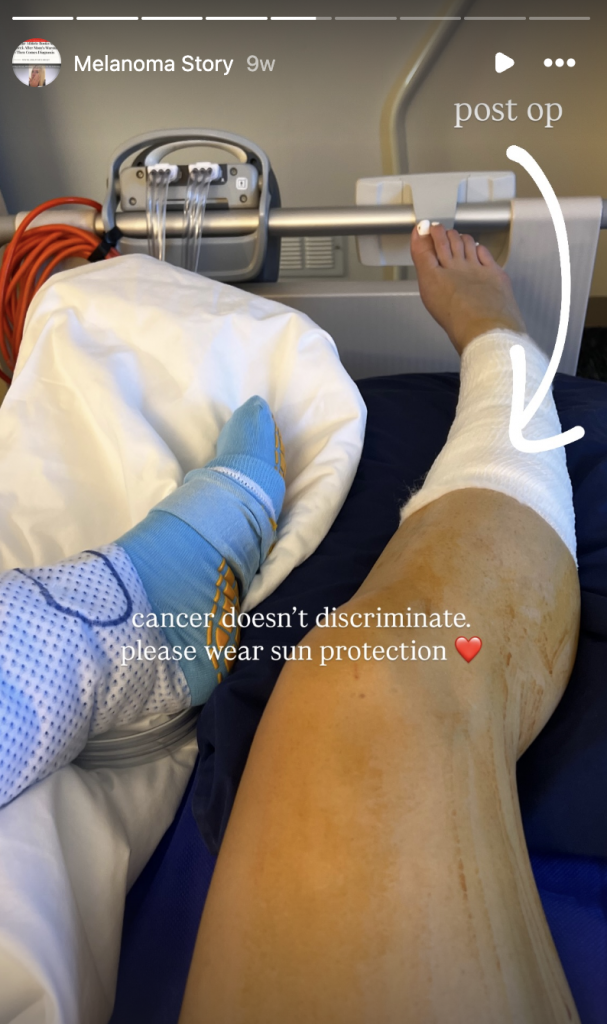
In one post, alongside a photo of her bandaged leg after surgery, she wrote, “cancer doesn’t discriminate. please wear sun protection.”
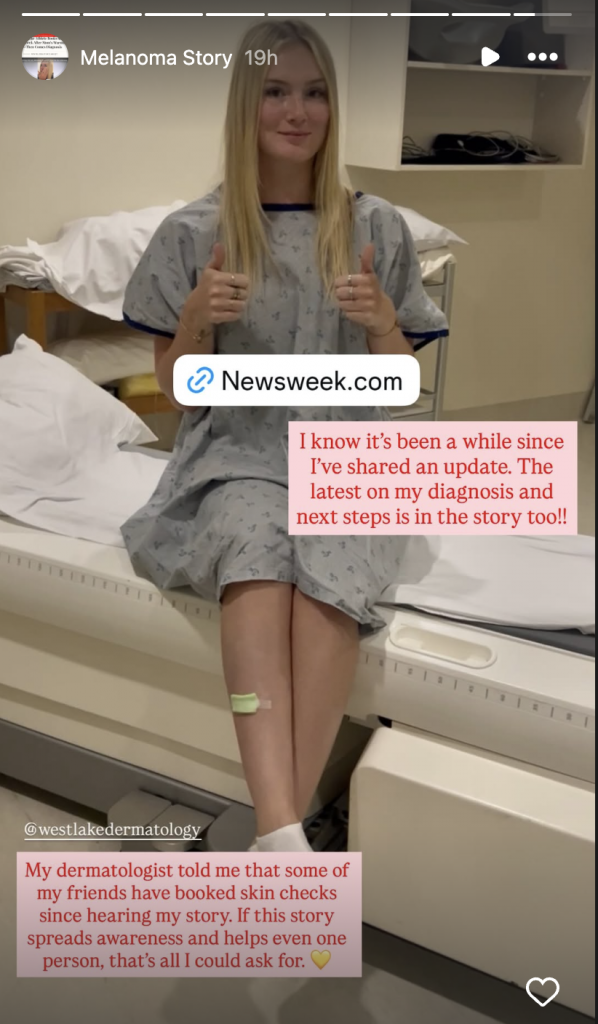
Her latest update shares some good news: her dermatologist told her that some of her friends have booked skin checks after hearing her story. If it helps even one person, she wrote, that’s all she could ask for.
In her latest update, she shared that some of her friends booked skin checks after hearing her story, writing that helping even one person is all she could ask for.
View this post on Instagram
RELATED: Am I at High Risk for Melanoma?
Understanding Melanoma
Melanoma starts in the same cells that give your skin, hair, and eyes their color. In melanoma, the cells change in a way that allows them to spread to other organs.
Changes to a mole you’ve had for a while or a new growth on your skin could be signs of melanoma.
You’re most likely to find melanoma on sun-exposed skin areas like your face, neck, arms, and legs. Surprisingly, you might also find them in other places as well, like:
- The palms of your hands or soles of your feet
- On your eyes or mouth
- Under your nails
The top way to protect yourself is by staying out of the sun, especially during peak hours, and avoiding unprotected sun exposure because ultraviolet (UV) radiation can lead to melanoma.
According to experts like Dr. Anna Pavlick, an oncologist at NYU’s Perlmutter Cancer Center, tanning beds pose ultraviolet radiation risks for skin cancer and should be avoided completely.
RELATED: How Do I Know My Skin Cancer is Gone?
Dr. Pavlick notes that people who are covered with moles stand a higher risk of developing skin cancer, especially people with dysplastic nevis syndrome, or “atypical” moles.
Atypical moles are those that are unusual-looking and, when seen under a microscope, they have irregular features. Although usually benign, a high number of atypical moles do signal an increased risk for melanoma, according to the Skin Cancer Foundation which says people with 10 or more atypical moles have 12 times higher risk of developing melanoma.
Melanoma Treatment Options
Melanoma treatment has come a long way. Survival rates have risen dramatically, thanks to a “treatment revolution,” say SurvivorNet’s experts. With breakthrough treatments like targeted therapy and immunotherapy now available, people who are diagnosed today have a much better chance of living a long and healthy life than ever before.
If you’re diagnosed with melanoma, there’s a good chance surgery is going to be the treatment your doctor recommends. In the early stages of the disease, removing the cancer should lead to a cure. The question is typically not whether you’ll get surgery, but which kind you’ll have.
WATCH: Dermatologic Surgeon Dr. Nima Gharavi, On The “Gold Standard Treatment” For Melanoma
For an early-stage melanoma that is close to the skin surface, Mohs surgery might be an option. This technique removes skin cancer, layer by layer, until all the cancer is gone.
In general, stage I melanoma surgery consists of the simple, in-office removal of the cancerous cells by a dermatologist. If the cancer is thicker, your surgeon will remove it through a technique called wide excision surgery.
The removal of stage II and III melanomas are performed by surgeons or surgical oncologists, not dermatologists. You may also have a sentinel lymph node biopsy to see if the melanoma has spread to the first lymph node where it’s most likely to travel. If your cancer has reached this first lymph node, it may have spread to other neighboring lymph nodes, and possibly to other organs. Where the cancer is will dictate your treatment.
After surgery, the removed tissue and lymph nodes will go to a specialist called a pathologist, who will measure the melanoma and find out if it has clear margins. Having clear margins means the cells around the area of tissue that was removed don’t contain any melanoma. When there aren’t any cancer cells left around the removed area, your cancer is less likely to come back.
Once your cancer spreads, treatment gets a little more complicated, but there are still ways to stop it. New treatments have vastly improved the outlook for people with metastatic, or stage IV, melanoma.
Targeted drugs and immunotherapy have been shown to be more effective than chemotherapy. So, with many more choices, there is no standard treatment. Treatment will vary based on your condition and whether there is recurrent disease.
Immunotherapy Advances Offer New Hope in Melanoma Treatment
Melanoma treatment, like all cancer care, is highly individualized—shaped by tumor stage, location, and patient-specific factors. Yet across the spectrum, a multi-pronged approach is common, often combining surgery, immunotherapy, targeted therapies, and radiation.
Among these, immunotherapy has emerged as a transformative force in oncology. Rather than attacking cancer cells directly, it empowers the body’s own immune system to do the work. One standout example is pembrolizumab—commercially known as Keytruda—a checkpoint inhibitor that’s reshaping outcomes for patients with advanced melanoma.
Checkpoint inhibitors, like pembrolizumab, help the immune system do its job by removing the “invisibility cloak” that cancer cells use to hide. Normally, a protein called PD-1 acts like a brake on T cells, keeping them from attacking healthy cells. But cancer takes advantage of that brake to avoid being targeted. Pembrolizumab blocks PD-1, releasing the brake and letting T cells go after cancer cells more aggressively—just like they’re meant to.
“We have known for a while now that immunotherapy is a very important weapon in the fight against melanoma,” Dr. Janice Mehnert, associate director of clinical research at NYU Langone’s Perlmutter Cancer Center, previously explained to SurvivorNet.
“This study sought to investigate whether giving the anti-PD-1 antibody pembrolizumab to melanoma patients with bulky stage IIIB through stage IV disease may be superior to the standard of care approach, which is surgery followed by immunotherapy.”
The implications are significant. Instead of waiting until after surgery to deploy immunotherapy, researchers are exploring whether earlier intervention with pembrolizumab could improve outcomes for patients with more aggressive disease.
Used across multiple cancer types, immunotherapy has already revolutionized treatment paradigms. In melanoma, it’s not just a promising option—it’s a game-changer.
RELATED: Melanoma Relapse Treatment: Advances on the Horizon
FDA-Approved Immunotherapy for Melanoma
There are several FDA-approved immunotherapies for melanoma. Each is approved for certain instances of melanoma.
- Ipilimumab (Yervoy)
- Nivolumab (Opdivo)
- Pembrolizumab (Keytruda)
- Atezolizumab (Tecentriq)
- Nivolumab + relatlimab (Opdualag)
- Pembrolizumab + berahyaluronidase (Keytruda Qlex)
- Aldesleukin (Proleukin)
- Interferon alfa-2b (Intron A)
- Peginterferon alfa-2b (Sylatron/PEG-Intron)
- Talimogene laherparepvec (Imlygic)
- Vusolimogene oderparepvec (Tudriqev)
- Lifileucel (Amtagvi)
- Tebentafusp-tebn (Kimmtrak)
- Hepzato (melphalan, liver-directed)
The goal is to steadily reduce the risk of recurrence in all patients. It’s not a one-size-fits-all approach. Some people may not be candidates for this therapy, and side effects vary from person to person.
Research has found that immunotherapy drugs such as Keytruda (pembrolizumab) and Opdivo (nivolumab) helped some people live longer.
The following immunotherapy drug combinations also exist for melanoma:
- Yervoy + Opdivo (ipilimumab + nivolumab) – extends survival further than single drugs, but with higher risk of side effects
- Opdivo + relatlimab (Opdualag) – newer combo, included in NCCN guidelines
Other immunotherapy approaches consist of:
- T-VEC (Imlygic) – a virus-based therapy injected directly into melanoma tumors
- Lifileucel (Amtagvi) – a newer cell-based therapy using a patient’s own immune cells (taken from the tumor, grown in a lab, then infused back in); used for advanced melanoma when other treatments haven’t worked
For those with the BRAF mutation, targeted drugs which shrink or slow the tumor can be a good option. This could include a combination of drugs, such as:
- Zelboraf (vemurafenib) and Cotellic (cobimetinib)
- Braftovi (encorafenib) and Mektovi (binimetinib)
- Tafinlar (dabrafenib) and Mekinist (trametinib)
- Zelboraf (vemurafenib) and Cotellic (cobimetinib) can also be combined with atezolizumab.
“Every patient is different and every situation is different,” said Dr. Pavlick. She emphasized that “there is no cookie-cutter recipe,” for treating stage IV melanoma.
RELATED: There Is No “Cookie Cutter Recipe” for Treating Stage Four Melanoma
Questions to Ask Your Doctor
If you are diagnosed with skin cancer, you may have some questions for your doctor. SurvivorNet suggests the following to help you on your cancer journey.
- What type of skin cancer do I have?
- What treatment options exist for my type of melanoma?
- Will insurance cover this treatment?
- Would treatment through a clinical trial make sense for me?
- What resources exist to help manage my anxiety because of this diagnosis?
Check out SurvivorNet’s proprietary AI tool “My Health Questions,” designed specifically for patients and caregivers.
WATCH: How One Cancer Survivor and Her Sister Used “My Health Questions” to Navigate Care
Leading Experts Urge Us to Be Proactive
“If I had any advice for you following a cancer diagnosis, it would be, first, to seek out multiple opinions as to the best care,” National Cancer Institute Chief of Surgery Steven Rosenberg told us in a previous interview, “because finding a doctor who is up to the latest of information is important.”
As we highlight in several areas of SurvivorNet, highly respected doctors sometimes disagree on the right course of treatment, and advances in genetics and immunotherapy are creating new options. Also, in some instances the specific course of treatment is not clear cut. That’s even more reason why understanding the potential approaches to your disease is crucial.
At the National Cancer Institute, there is a patient referral service that will “guide patients to the right group depending on their disease state so that they can gain access to these new experimental treatments,” Rosenberg says.
Cancer Research Legend Urges Patients to Get Multiple Opinions
Furthermore, getting another opinion may also help you avoid doctor biases. For example, some surgeons own radiation treatment centers. “So there may be a conflict of interest if you present to a surgeon that is recommending radiation because there is some ownership of that type of facility,” Dr. Jim Hu, director of robotic surgery at Weill Cornell Medical Center, tells SurvivorNet.
Other reasons to get a second opinion include:
- To see a doctor who has more experience treating your type of cancer
- You have a rare type of cancer
- There are several ways to treat your cancer
- You feel like your doctor isn’t listening to you, or isn’t giving you good advice
- You have trouble understanding your doctor
- You don’t like the treatment your doctor is recommending, or you’re worried about its possible side effects
- Your insurance company wants you to get another medical opinion
- Your cancer isn’t improving on your current treatment
RELATED: Be Pushy, Be Your Own Advocate, Says Leading Expert
Bottom line, being proactive about your health could be a matter of life or death. Learn as much as you can from as many experts as you can, so that you know that you did your best to take control of your health.
Contributing: SurvivorNet Staff
Learn more about SurvivorNet's rigorous medical review process.


