
Understanding Active Surveillance for Prostate Cancer
- Active surveillance is a structured medical strategy, not inaction. Patients on active surveillance follow a regular schedule of PSA blood tests, prostate exams, MRI scans, and periodic biopsies — all designed to detect meaningful changes early while avoiding the side effects of unnecessary treatment.
- Monitoring does not mean ignoring. Dr. Andrew G. Winer, a urologic oncologist at NYC Health + Hospitals/Woodhull says “We’re not ignoring the cancer; we’re making sure we treat it at the right time.”
- The decision to shift from surveillance to active treatment is based on a pattern of evidence — including biopsy results, MRI findings, and PSA trends — not one abnormal number. Additional testing is typically done to confirm any concerning change before a treatment recommendation is made.
- Transitioning to more active treatment is the program working, not failing. If monitoring eventually leads to treatment, Dr. Winer frames it as a success: “We identified a change at a point when treatment can still be offered with curative intent.” The goal was never to avoid treatment indefinitely — it was to ensure treatment happens only when, and exactly when, it is needed.
One of the most important things Dr. Andrew G. Winer, a urologic oncologist at NYC Health + Hospitals/Woodhull, wants patients to understand is that active surveillance is not passive.
Read MoreTreatments like surgery or radiation can cause significant side effects, including urinary leakage and erectile dysfunction. If the cancer poses little immediate threat, exposing a patient to those disruptive side effects may do more harm than good.
Active surveillance preserves your quality of life now while keeping all treatment options open for later, if they are ever needed.
As Dr. Winer puts it: “We’re not ignoring the cancer; we’re making sure we treat it at the right time, if and when treatment becomes necessary.”
What a Typical Schedule Looks Like
Active surveillance follows a clear, structured calendar of check-ins and tests.
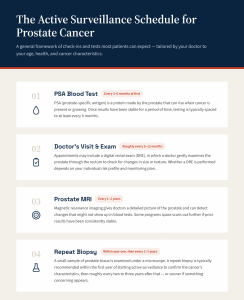
While the exact schedule is tailored to each individual — based on age, overall health, and the specific characteristics of the cancer — Dr. Winer describes a general framework that most patients can expect:
- PSA blood test. PSA (prostate-specific antigen) is a protein produced by the prostate that can rise when cancer is present or growing. This blood test is typically done every 3 to 6 months at first, then at least every 6 months once results have been stable for a while.
- Doctor’s visit and prostate exam. Appointments happen roughly every 6 to 12 months and may include a digital rectal exam (DRE), in which a doctor gently examines the prostate through the rectum to check for changes in size or texture. Whether a DRE is performed depends on your individual risk profile and monitoring plan.
- Prostate MRI. Magnetic resonance imaging gives doctors a detailed picture of the prostate and can detect changes that might not show up in blood tests. This is often done every one to two years, though some programs space these out further if prior scans have been consistently stable.
- Repeat biopsy. A biopsy — in which a small sample of prostate tissue is examined under a microscope — is typically recommended within the first year of starting active surveillance to confirm the cancer’s characteristics. After that, biopsies are usually repeated approximately every two to three years, or sooner if something concerning appears.
At every visit, Dr. Winer and his team review the PSA trend over time, ask about any urinary or other symptoms, and decide whether additional testing is needed.
WATCH: Active Surveillance for Low Risk Prostate Cancer
He stresses one reassurance that patients often need to hear: “One abnormal PSA does not automatically mean the cancer is progressing. PSA can fluctuate for many reasons, so we often repeat the test before making any decisions.”
What Would Actually Trigger a Move to Treatment?
This is often the question patients most want answered: “When would this change?”
Dr. Winer is clear that the decision to move from active surveillance to a more active and aggressive treatment is not made lightly, and it is never based on a single data point.
The most important trigger is evidence that the cancer itself has become more aggressive, not just that one number went up.
Specific findings that would raise concern include:
- A biopsy showing a higher Gleason grade — these are scoring systems pathologists use to describe how abnormal cancer cells look under a microscope, with higher scores indicating more aggressive behavior
- A significant increase in the amount of cancer detected in the prostate
- Consistent or substantial changes on MRI suggesting the tumor is growing or becoming more concerning
- Repeatedly rising PSA levels, particularly when supported by other findings
- A new abnormality felt during a prostate exam
Importantly, a change in PSA or MRI findings typically prompts further evaluation — often a repeat PSA, a new MRI, and possibly a biopsy — before any treatment recommendation is made.
Guidelines from major oncology organizations generally recommend confirming cancer progression with a biopsy before switching to definitive treatment.
You Will Have Time — And That Is by Design
One of the most common fears patients have is that things could go wrong quickly and without warning. Dr. Winer’s experience tells a different story.
“Most patients do not suddenly go from ‘everything is fine’ to needing treatment the next day,” he explains.
“Active surveillance is designed to identify changes early, often over months or years. In many cases, there is time to repeat testing, review the findings carefully, and discuss treatment options thoughtfully.”
“Active surveillance cannot guarantee that progression will always be detected far in advance. This is why adhering to the recommended follow-up schedule is so important,” Dr. Winer adds.
Data from Johns Hopkins, which has followed more than 2,000 men on active surveillance since 1995, supports this reassurance. The rate of prostate cancer-specific death in their program has been approximately 0.1% — or about one in a thousand — over 15 years of follow-up.
WATCH: To Treat or Not to Treat
If Treatment Becomes Necessary, That Is Not a Failure
So, what if surveillance eventually leads to treatment?
“Moving from active surveillance to treatment is not a failure of the surveillance program — it means the monitoring worked,” Dr. Winer says.
“We identified a change at a point when treatment can still be offered with curative intent.”
The goal of active surveillance was never to avoid treatment forever. It was to avoid unnecessary treatment while making sure that necessary treatment happens at exactly the right moment.
Learn more about SurvivorNet's rigorous medical review process.
