Large B-Cell Lymphoma: Understanding Who Is a Candidate for CAR T-Cell Therapy
For many people living with diffuse large B-cell lymphoma (LBCL)—particularly those whose disease has come back or not responded to standard treatment—CAR T-Cell Therapy offers new hope.However, CAR T-Cell Therapy is not appropriate for everyone. It is a highly specialized treatment, and determining whether a patient is eligible requires careful consideration of medical history, prior treatments, overall health, and logistical factors. This article explains who may be a candidate for CAR T-Cell Therapy, what might disqualify someone, and what other treatment options exist if CAR T-Cell Therapy is not possible.
Read MoreWhat Is CAR T-Cell Therapy?
To Learn more about CAR T-Cell therapy, check out CAR T-Cell Therapy Explained: What Diffuse Large B-Cell Lymphoma Patients Should Know.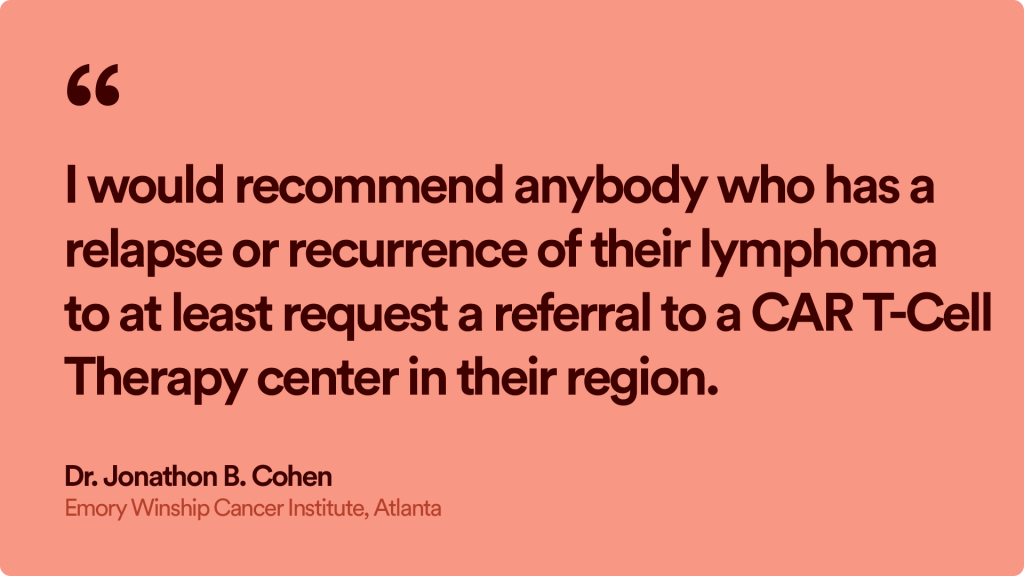
Who Is Typically Considered for CAR T-Cell Therapy?
CAR T-Cell is not a first-line treatment for large B-cell lymphoma. Most patients first receive a standard combination chemotherapy regimen such as R-CHOP (rituximab, cyclophosphamide, doxorubicin, vincristine, and prednisone). If the lymphoma either fails to respond (refractory disease) or returns after initial remission (relapsed disease), doctors will consider other options such as salvage chemotherapy, stem cell transplantation, or CAR T-Cell Therapy. However, CAR T-Cell Therapy therapy has emerged as the preferred option for eligible patients especially in those with early relapse (<12 months) or refractory disease. Dr. Cohen explains, “we’ve recognized the importance of offering CAR T therapy for those patients at the time of their first relapse, the first time the disease comes back, especially in those with some of these higher risk features like early recurrence…and has really changed the way we think about patients who have experienced this event.”
You may be a candidate for CAR T-Cell Therapy if you meet the following general criteria:
1. Diagnosis and Disease Type – CAR T-Cell Therapy is approved for several subtypes of aggressive B-cell lymphomas, including:
- Diffuse large B-cell lymphoma (DLBCL)
- High-grade B-cell lymphoma
- Primary mediastinal B-cell lymphoma (PMBCL)
- Transformed follicular lymphoma (follicular lymphoma that has changed into DLBCL)
Some CAR T-Cell Therapy products are also being studied for other lymphomas and even earlier lines of therapy in ongoing clinical trials.
2. Prior Treatment History
Patients eligible for CAR T-Cell Therapy have usually received at least one or two previous treatments. In certain situations, CAR T-Cell Therapy may be used after failure of second-line therapy instead of an autologous stem cell transplant. Your oncologist will review your prior responses and determine whether CAR T-Cell Therapy could offer a better chance for durable remission.
3. General Health and Performance Status
Because CAR T-Cell Therapy can cause strong immune reactions, patients must be in reasonably good overall health to tolerate it. Doctors assess this using a performance status scale (such as ECOG). Patients who can perform most daily activities independently (ECOG 0–2) are generally good candidates. Those with severe weakness or extensive medical problems may face higher risks.
4. Adequate Organ Function
Before treatment, your care team will check that your heart, lungs, liver, and kidneys are functioning well enough. This helps ensure that your body can handle the preparatory chemotherapy and any possible side effects of CAR T-Cell Therapy.
5. Access to a Certified Treatment Center
CAR T-Cell Therapy is only available at specialized hospitals and cancer centers certified to deliver cellular therapy. These centers have teams trained to manage potential complications such as cytokine release syndrome (CRS) and neurotoxicity (ICANS). The treatment usually requires close inpatient monitoring for several days after infusion.
Diffuse Large B-Cell Lymphoma and CAR T-Cell Therapy: When to Seek a Second Opinion
What Might Disqualify a Patient from CAR T-Cell Therapy?
Not every patient who wants CAR T-Cell Therapy will qualify. Several medical or logistical factors may make the treatment less safe or effective. Common reasons for ineligibility include:
- Severely impaired organ function — heart failure, advanced liver disease, or kidney failure can make treatment unsafe.
- Uncontrolled infections — active viral, bacterial, or fungal infections must be treated before CAR T-Cell Therapy can proceed.
- Uncontrolled central nervous system (CNS) involvement — lymphoma spreading to the brain or spinal fluid can complicate treatment, though some centers treat carefully selected cases.
- Rapidly progressive disease — because manufacturing CAR T-Cells takes several weeks, patients whose disease is growing very quickly may need immediate alternative therapy while waiting for CAR T-Cells to arrive.
- Severe autoimmune disease or ongoing high-dose immunosuppression — these conditions can interfere with T-cell function or increase toxicity risk.
- Poor performance status or frailty — patients who are too weak to tolerate the immune effects of therapy may be better served with other options.
- Lack of caregiver support — patients need monitoring and someone with ability to join them for appointments
While you are waiting for CAR T-Cells to be manufactured, your care team might use “bridging therapy”—short-term treatment to control disease—while your CAR T-Cells are being manufactured or your health improves.
If I’m Not a Candidate for CAR T-Cell Therapy, What Are My Options?
Fortunately, treatment options for relapsed or refractory LBCL continue to expand. Even if CAR T-Cell Therapy is not appropriate, there are effective alternatives, including:
- Bispecific Antibodies such as epcoritamab, glofitamab, or mosunetuzumab, which redirect your body’s existing T cells to attack lymphoma cells. These can often be given in an outpatient setting and work similarly to CAR T-Cell Therapy but are “off-the-shelf.”
- Antibody-Drug Conjugates (ADCs) such as brentuximab vedotin, polatuzumab vedotin or loncastuximab tesirine, which deliver chemotherapy directly to cancer cells while sparing most healthy tissue.
- Targeted Therapies such as tafasitamab, lenalidomide, or ibrutinib, used in certain lymphoma subtypes or genetic profiles.
- Clinical Trials offering access to next-generation CAR T-Cell Therapy constructs, novel bispecifics, or combination immunotherapies.
- Palliative or Symptom-Focused Therapy, including low-dose chemotherapy or radiation, aimed at maintaining comfort and quality of life.
Your oncologist can help determine which of these options fits best with your medical condition and treatment goals.
Learn more about SurvivorNet's rigorous medical review process.