What You Should Know
- For patients facing a relapse of a diffuse large B-cell lymphoma, a second opinion at a CAR T-Cell Therapy center — a specially accredited cancer center with the resources to deliver CAR T-Cell treatment — can be an essential step on the path to a potential cure.
- Having a second opinion at a CAR T-Cell Therapy center maximizes your chances of getting the best treatment; the faster you have a consultation at a CAR T-Cell Therapy, the better, because time matters and it is aligned with positive results.
More Patients Than Ever Qualify—Here’s Why You Should Get Evaluated for CAR T-Cell Therapy
New research is rewriting the playbook on treatment for a relapse of diffuse large B-cell lymphoma—and it starts with getting evaluated for CAR T-Cell Therapy before making any major treatment decisions.When diffuse large B-cell lymphoma (DLBCL) comes back, treatment decisions often need to be made quickly and can be life-changing. At that point, your oncologist may start discussing traditional treatment options such as chemotherapy and a transplant. However, emerging evidence suggests that a consultation at a CAR T-Cell Therapy center — a specialized hospital equipped to deliver CAR T-Cell treatment — early in the decision-making process can be critical.
Read More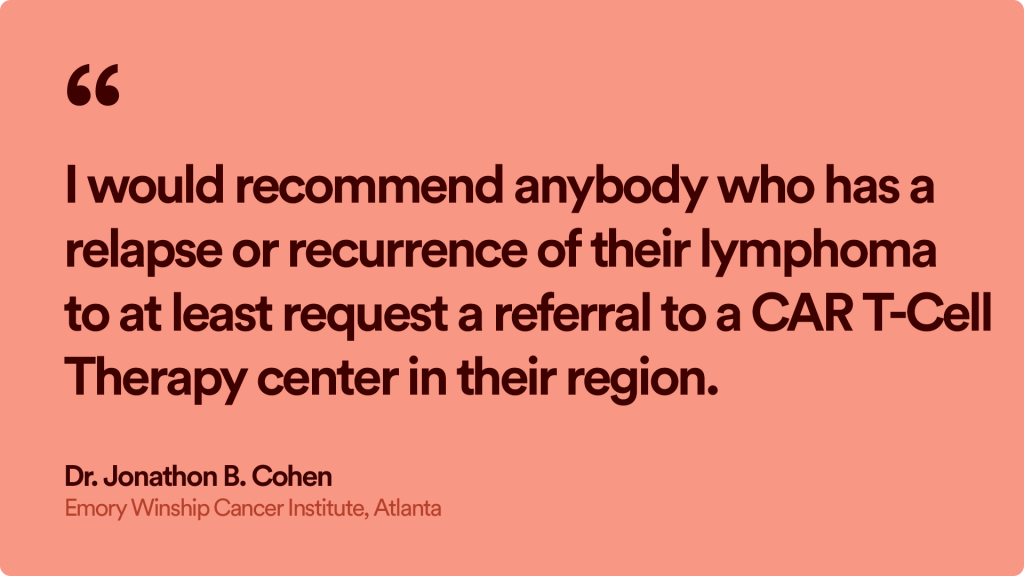 Although the recommendation seems straightforward, many eligible patients never receive a CAR T-Cell Therapy consultation. In some cases, community oncologists assume the patient is not an appropriate candidate; in others, patients are deterred by distance or logistical concerns as CAR T-Cell Therapies is only available at specialized centers within large cancer centers. Physicians at CAR T-Cell Therapy centers emphasize, however, that eligibility criteria for CAR T-Cell Therapy has evolved with new FDA approvals that make more patients eligible for this groundbreaking treatment.
 Three Distinct Products, One Goal: What Are Your Options for CAR-T Cell Therapy?
What To Expect At CAR T-Cell Therapy Consultations
The first thing most patients learn is that the conversation is not a commitment. The team will review your medical history, recent scans, and lab results. They’ll look at your overall health, how aggressive your lymphoma is, and whether you’d need “bridging therapy” to keep the cancer under control while the CAR T-Cells are being manufactured.
You’ll also learn crucial details that are not currently discussed in general oncology clinics: how long the process takes, where you would need to stay during recovery, what kind of monitoring happens afterward, and what kind of outcomes patients like you have had.
Even if the decision at the end of that visit is not to go forward with CAR T-Cell Therapy, you’ll leave with a plan. You’ll know whether you might qualify in the future, what steps could improve your candidacy, and what alternative treatments make the most sense in your situation. “The worst thing that happens,” Dr. Cohen says, “is that you’ve covered your bases.”
CAR T-Cell Therapy for Diffuse Large B Cell Lymphoma: Do I Qualify?
What the Data Shows
For people with diffuse large B-cell lymphoma that relapses after initial treatment, the traditional plan used to be clear: more chemotherapy, then a stem cell transplant if you were healthy enough to handle it. But, recent studies have changed that thinking.
In one major trial called ZUMA-7, patients whose lymphoma came back within a year were randomly assigned to either standard treatment (chemo plus transplant) or CAR T-Cell Therapy. The results were striking: CAR T-Cell Therapy led to longer periods without disease progression, and more patients were alive years later. At the four-year mark, about 55% of those treated with CAR T-Cell Therapy were still alive, compared to roughly a third of those who went through the traditional route.
A second trial, called TRANSFORM, confirmed those gains using a different CAR T-Cell Therapy product. People treated earlier, after just one relapse, had higher remission rates and went longer before their disease returned. A third study, called BELINDA, did not show a benefit, but researchers pointed out that long delays between patient referral and treatment were a major factor. In other words: time matters. Getting referred quickly to a CAR T-Cell Therapy center can make the difference between being eligible and missing that window.
Why Does This Consultation Matter?
Every major study on CAR T-Cell Therapy underscores one theme: timing and coordination are paramount. In ZUMA-7 and TRANSFORM studies we have mentioned, the centers that treated patients fastest saw the strongest survival results. In BELINDA, where the process was slower, outcomes were weaker. That’s not a coincidence.
CAR T-Cell Therapy works by collecting your own T cells, reprogramming them to recognize and kill lymphoma cells, and infusing them back into your body. It’s complex, but it’s also highly personalized. Experienced centers have streamlined systems to get patients from referral to treatment within a few weeks. That speed can determine whether the cancer stays under control long enough for the therapy to work.
Expert Resources on Non Hodgkin Lymphoma
- CAR-T Cell Therapy: A “Revolution” in Cancer Treatment
- Bispecific Antibodies vs. CAR T-Cell Therapy: What Are the Differences Non-Hodgkin Lymphoma Patients Need to Know?
- CAR T-Cell Therapy for Non-Hodgkin Lymphoma
- CAR-T Therapy is a Game-Changer for Common Type of Non-Hodgkin Lymphoma
- CAR T-Cell Therapy: A Step-By-Step Guide to Having This Breakthrough Treatment
- CAR T-Cell Therapy: Hope, Hurdles, and What to Expect
So, Is a Second Opinion Optional?
It’s not about doubting your oncologist. It’s about making sure your treatment plan reflects the latest evidence and the full range of options. CAR T-Cell Therapy is no longer experimental or “last resort.” For some people, it’s now the preferred second-line treatment. But knowing whether it’s right for you requires evaluation by a team that does it regularly.
If you live in or near a large medical hub, like Atlanta, there’s likely an authorized CAR T-Cell Therapy center within reach. These programs work closely with community oncologists to share care, meaning you may only need to travel for the key steps: the consultation, the infusion, and the initial monitoring period.
“I think that the first step is just helping folks understand that nothing is mandatory, that this is a shared decision. My job is to provide the best information and guidance I can as far as what to expect with individual therapies, but then ultimately it’s up to them and whatever they choose, we support. We certainly are not in a business of convincing people they must do one therapy over another,” Dr. Cohen adds.
Even if you ultimately continue with standard chemotherapy or transplant, you’ll have confidence that you explored every path. That peace of mind, patients often say, is worth the extra trip.
Learn more about SurvivorNet's rigorous medical review process.